



‘Ballot Or Barricades’: Sowore Warns Nigerians Could Revolt If Expectations For 2027 Elections Are Dashed

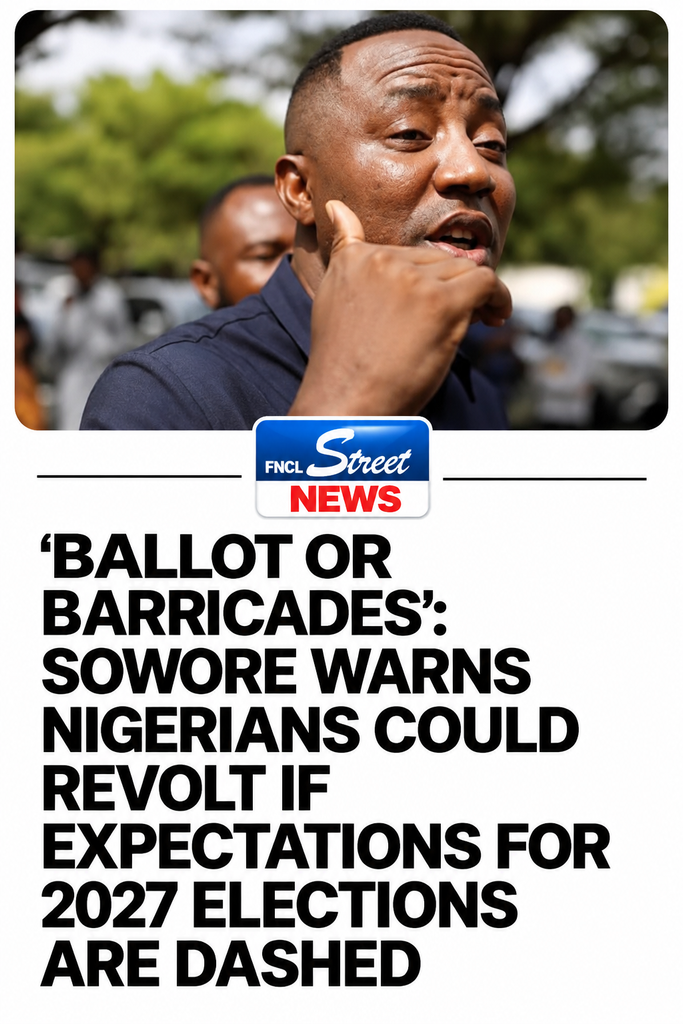
Human rights activist and former presidential candidate Omoyele Sowore has warned that Nigerians could resort to mass resistance if their expectations for credible and transparent elections in 2027 are frustrated, raising concerns about public confidence in the country’s democratic institutions ahead of the next general election.
The warning, captured in the phrase “Ballot or Barricades,” underscores the growing debate over whether Nigerians will be able to use the ballot box to express their political choices freely and have those choices respected by the authorities.
Sowore, a prominent pro-democracy campaigner and former presidential candidate, has consistently criticised successive Nigerian governments over governance, electoral credibility, corruption and restrictions on citizens’ rights. His latest warning places renewed attention on the responsibilities of the Independent National Electoral Commission (INEC), political parties and security agencies as preparations for the 2027 elections continue.
The activist’s remarks suggest that public frustration could deepen if voters believe the electoral process does not reflect their choices. However, the warning represents Sowore’s assessment of a possible public reaction and should not be interpreted as confirmation that a nationwide revolt will occur.
Nigeria’s 2027 general elections are expected to be a significant test of the country’s democratic institutions, particularly amid debates over electoral transparency, political competition, economic hardship and the credibility of election administration.
For many citizens, elections provide an opportunity to hold political leaders accountable, change governments peacefully and influence the direction of public policy. Concerns arise when voters question whether their votes will be properly counted or whether the institutions responsible for conducting elections can operate independently of political pressure.
INEC will therefore face considerable scrutiny over its preparations, including voter registration, the deployment of election technology, the timely distribution of electoral materials and the accurate collation and announcement of results. Public confidence in these processes will be important to the acceptance of the eventual outcome.
The commission has also faced calls from political stakeholders and election observers to address problems associated with vote-buying, voter intimidation, misinformation and weak enforcement of electoral regulations. These concerns have featured prominently in discussions about the safeguards required for credible elections in 2027.
Political parties and candidates will also have a responsibility to respect electoral rules, avoid inciting violence and resolve disputes through lawful channels. The conduct of campaigns, the treatment of opposition figures and the freedom of citizens to support candidates of their choice are all likely to influence public perceptions of the electoral process.
Security agencies are expected to protect voters, election officials and electoral materials without showing favouritism towards any political party. Any allegations of intimidation, excessive force or political interference will require credible investigation to prevent further erosion of public trust.
Sowore’s warning also comes against the background of broader concerns about the relationship between economic conditions and political expectations. Rising living costs, unemployment, insecurity and dissatisfaction with public services can intensify calls for accountability, particularly when political leaders make promises that citizens believe have not been fulfilled.
Nevertheless, economic hardship and political dissatisfaction do not automatically translate into revolt. Public reactions depend on a range of factors, including the credibility of available political alternatives, the openness of democratic institutions, the organisation of civic movements and the ability of authorities to address grievances peacefully.
Nigeria has experienced periods of intense political mobilisation in the past, with protests and civic campaigns often driven by concerns about governance, public accountability and citizens’ rights. Such experiences have continued to shape discussions about the importance of protecting peaceful assembly and ensuring that citizens can express dissatisfaction without fear of unlawful punishment.
The phrase “Ballot or Barricades” frames the coming election as a test of whether democratic participation can provide an effective channel for expressing public demands. It also highlights the risks associated with a loss of confidence in electoral institutions, although any suggestion of future unrest remains a warning rather than a certainty.
Political observers and civic organisations have repeatedly emphasised the need for transparent election administration, credible dispute-resolution mechanisms and accountability for electoral offences. These measures can help ensure that disagreements over results are addressed through legal processes rather than violence.
The responsibility for a credible election will not rest on INEC alone. Political parties must respect the rules, candidates must communicate responsibly, security agencies must remain impartial, and citizens must be able to participate without intimidation or coercion.
As the country moves closer to the 2027 polls, attention is likely to focus on the practical steps being taken to strengthen electoral safeguards and rebuild public confidence. Clear communication from electoral authorities, timely responses to complaints and transparent handling of disputed results could be important in reducing suspicion and tension.
Sowore’s warning serves as a reminder of the potential consequences when citizens lose confidence in democratic processes. Whether that warning translates into wider public action will depend on developments in the coming months and how political institutions respond to voters’ expectations.
Street News Reporters will continue to monitor developments surrounding the 2027 elections, including responses from INEC, political parties and civil society groups, as Nigerians prepare for another major test of the country’s democratic process.
