



Sowore Condemns Sycophancy, Power Worship At Seyi Tinubu Colloquium, Calls For National Shaming Of Tinubu Regime

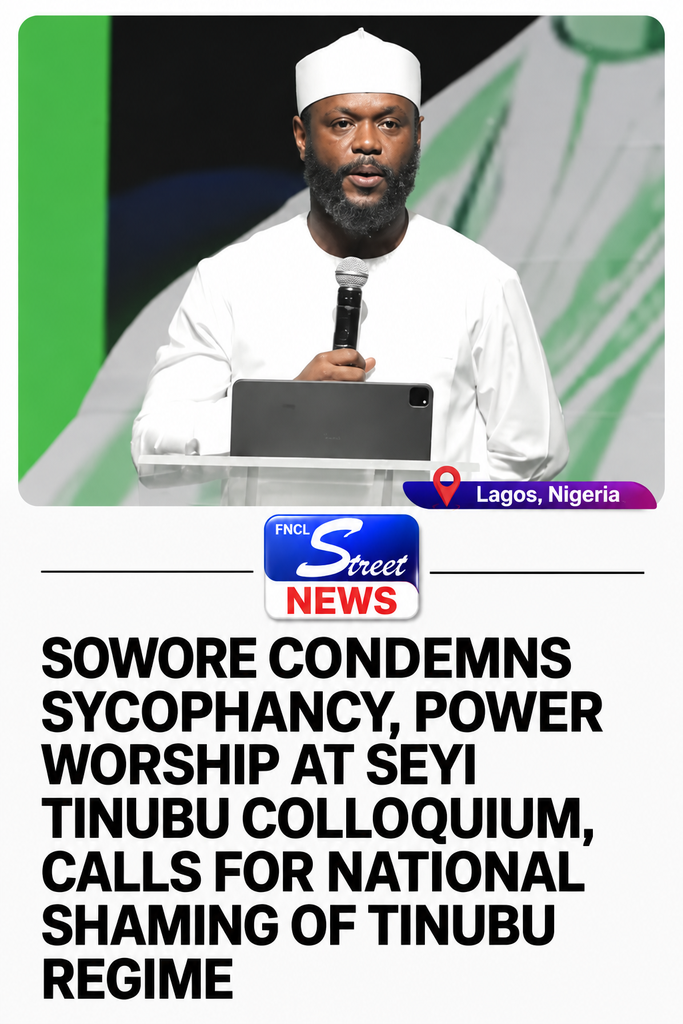
Human rights activist and African Action Congress (AAC) presidential candidate Omoyele Sowore has criticised the colloquium organised in honour of Seyi Tinubu, son of President Bola Tinubu, describing the event as an example of what he called sycophancy and the worship of political power in Nigeria.
Sowore made his position known in a post on X on Monday, October 12, 2026, following the inaugural Seyi Tinubu Colloquium held in Lagos. The event, themed “Shaping the Future Together,” brought together political leaders, government officials, business figures and youth advocates to discuss leadership, innovation, enterprise and national development.
Reacting to the gathering, Sowore questioned what Seyi Tinubu had contributed to Nigerian society to justify a major event attended by prominent personalities and broadcast on television stations. He challenged the organisers and participants to explain the public service, intellectual achievements or national contributions being recognised.
“What exactly has Seyi Tinubu contributed to Nigerian society to warrant this elaborate colloquium, attended by so many ‘prominent personalities’ and broadcast across major television stations?” Sowore asked.
The activist further questioned whether the event was organised to recognise measurable achievements or whether Seyi Tinubu’s family connection to the President played a significant role in the attention surrounding the gathering.
“What extraordinary public service, intellectual contribution, or national achievement is being celebrated?” he asked, adding that the event raised questions about whether public recognition was based on merit or simply on being the son of a sitting president.
Sowore described the gathering as a reflection of what he called a growing culture of sycophancy and power worship, arguing that influential individuals in Nigeria were increasingly celebrated because of their proximity to political authority. His criticism focused on the standards used to confer public recognition and the role of political connections in determining who receives national attention.
To support his argument, the AAC presidential candidate drew comparisons with politically prominent marriages involving members of the family of former President Umaru Musa Yar’Adua and serving state governors during Yar’Adua’s administration.
Sowore argued that the political attention surrounding those relationships eventually diminished after Yar’Adua died in May 2010. He cited the episode as an example of how public fascination with individuals associated with political power can change when the circumstances surrounding that power change.
The activist also criticised the timing of the Seyi Tinubu Colloquium, pointing to the economic and security difficulties confronting many Nigerians. He argued that hunger, unemployment, insecurity and the rising cost of living should receive greater national attention than celebrations involving people closely connected to those in government.
“At a time when millions of Nigerians are struggling with hunger, unemployment, insecurity, and economic hardship brought about by his father, we should be having national shaming of the Tinubu regime,” Sowore wrote.
He concluded his reaction by describing the occasion as a “sad day,” reiterating his dissatisfaction with what he viewed as the celebration of political privilege at a time when many citizens were experiencing hardship.
The colloquium took place at Eko Hotel and Suites on Victoria Island, Lagos, on October 12. Its organisers presented the inaugural edition as a platform for dialogue on leadership, innovation, youth participation, enterprise and collaborative nation-building.
The gathering attracted prominent figures from government and other sectors. President Bola Tinubu and Lagos State Governor Babajide Sanwo-Olu were among those reported to have spoken about youth inclusion and the need for young Nigerians to participate more actively in governance and policy development.
Other speakers also discussed issues relating to education, human capital development, innovation and the role of young people in shaping Africa’s future. The event’s stated objectives therefore centred on policy dialogue and national development, although Sowore questioned whether Seyi Tinubu’s personal achievements justified the scale of the recognition.
Seyi Tinubu, a lawyer and businessman, has developed a public profile through business activities and youth-focused initiatives. Supporters have also associated him with youth engagement and outreach programmes. However, Sowore’s central argument was that the public should be able to assess the basis for major honours and celebrations independently of family connections or political influence.
The controversy has renewed discussion about political privilege, public recognition and accountability in Nigeria. It has also highlighted differing views about whether events involving influential political figures provide useful platforms for dialogue or risk reinforcing perceptions that proximity to power receives disproportionate public attention.
Sowore’s comments remain his political assessment of the event and the broader political culture. His criticism does not, on its own, establish the organisers’ motives or settle the question of Seyi Tinubu’s contributions to society. Neither the criticism nor the event itself substitutes for an assessment of specific achievements, public programmes or outcomes.
As of the time of reporting, no direct response from Seyi Tinubu or the Presidency to Sowore’s specific criticism was included in the reports reviewed. It remains unclear whether either would respond to his questions about the purpose and basis of the colloquium.
Street News Reporters will continue to monitor reactions to the Seyi Tinubu Colloquium, including any response from the organisers, Seyi Tinubu or the Presidency, as debate continues over political privilege, public accountability and the standards for recognising contributions to Nigerian society.
