



ADEGBORUWA URGES TINUBU TO CALL UMAHI TO ORDER OVER LAGOS-CALABAR COASTAL HIGHWAY REALIGNMENT

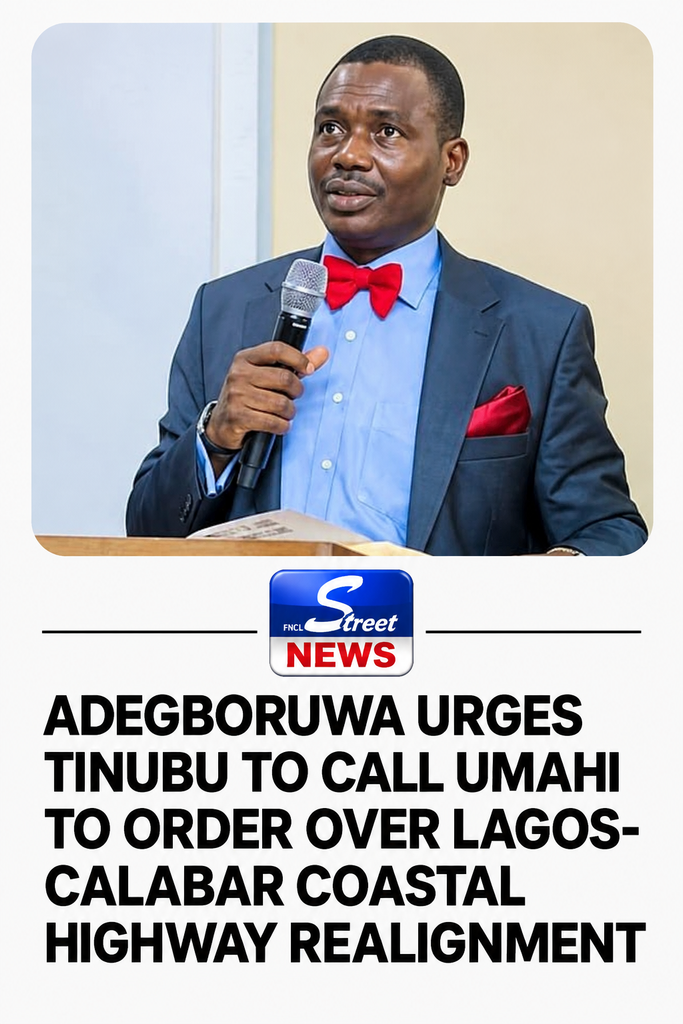
Senior Advocate of Nigeria (SAN), Ebun-Olu Adegboruwa, has called on President Bola Tinubu to intervene in the reported realignment of sections of the Lagos-Calabar Coastal Highway, warning that the changes could deprive coastal communities in Ondo and Delta states of the economic benefits expected from the multibillion-naira project.
Adegboruwa made the appeal in a statement dated Monday, October 12, 2026, titled “Lagos-Calabar Coastal Highway: Time for President Tinubu to Call Umahi to Order.” He urged the President to direct the Minister of Works, David Umahi, to explain the decisions behind the reported changes and ensure that the original development objectives of the highway are not undermined.
The senior lawyer expressed concern that sections of the highway initially intended to connect coastal communities could be redirected inland, potentially reducing access to the infrastructure and commercial opportunities the project was expected to create for residents along Nigeria’s Atlantic coastline.
He specifically highlighted the concerns of communities in Ilaje and other coastal parts of Ondo State, as well as settlements in Delta State, where residents depend on fishing, agriculture, maritime activities, tourism and related businesses for their livelihoods.
According to Adegboruwa, a highway promoted as a coastal development corridor should do more than provide a transport link between major cities. He argued that its route should also facilitate trade, improve access to markets, encourage investment and connect communities whose economic activities are closely tied to the coastline.
He warned that moving substantial sections of the road away from coastal settlements could leave some communities without direct access to the development opportunities associated with the project. He described the reported realignment as potentially damaging to the interests of the affected areas.
“There is nothing special about the coastlines of Ondo and Delta States when compared with Lagos,” Adegboruwa argued, questioning why engineering challenges should result in coastal communities in those states being bypassed.
The lawyer acknowledged that the Federal Government had cited difficult terrain, weak subsoil conditions, construction costs and flood resilience as reasons for reviewing parts of the highway’s alignment. However, he maintained that such considerations should be assessed alongside the project’s economic, environmental and social objectives.
He called for an independent technical assessment comparing the original coastal route with the revised alignment. According to him, the review should examine construction and maintenance costs, travel times, environmental effects, employment opportunities, commercial prospects and the distribution of economic benefits among the affected states.
Adegboruwa also urged the Federal Government to publish the relevant technical studies and environmental assessments supporting the changes. He said the public should be able to understand the reasons for the proposed route and evaluate whether the decisions adequately consider the long-term interests of coastal communities.
He warned that the environmental implications of the project required careful consideration, particularly in areas affected by coastal erosion, flooding, wetlands, mangrove ecosystems and changing climate conditions. He argued that both the original and revised routes should be assessed against these risks before major decisions are finalised.
The senior advocate further called for consultations with the communities that could be affected by the realignment. He proposed a stakeholder meeting involving the Federal Government, the governments of Ondo and Delta states, traditional rulers, community representatives, engineers, environmental experts and investors.
He also urged President Tinubu to direct the Ministry of Works to publish a clear explanation of the approved route and identify the communities that would be directly served or bypassed by the highway. Where technically, environmentally and economically feasible, he called for the retention or restoration of a viable coastal alignment through the affected states.
For settlements that may not be directly connected to the final route, Adegboruwa proposed complementary access roads and other supporting infrastructure. He argued that such measures would help ensure that communities outside the highway’s immediate corridor could still benefit from improved transport links and economic activity.
The Lagos-Calabar Coastal Highway is a major Federal Government infrastructure project designed to connect communities and economic centres along Nigeria’s southern coastline. Construction was officially flagged off in May 2024, and the project has remained a subject of public debate over its cost, route, environmental implications and expected economic benefits.
Umahi has defended the changes to the Ondo section, saying they were based on engineering considerations. In a separate report published on October 12, the minister said the ministry had encountered difficult terrain, including deep pits and areas with unsuitable subsoil conditions, which required redesigning the alignment to provide a stable foundation for the road.
The minister also maintained that the decision to connect the route to the existing East-West Road was intended to address engineering and flooding challenges. His position contrasts with Adegboruwa’s concerns about whether the revised alignment will adequately serve coastal communities in Ondo and Delta states.
The disagreement highlights a broader question about how major infrastructure projects should balance construction feasibility, environmental protection and the equitable distribution of economic benefits. While the government has cited technical reasons for the realignment, Adegboruwa is calling for an independent assessment that makes the basis for the decisions transparent.
The lawyer stressed that his appeal was not a demand for the government to disregard legitimate engineering concerns. Rather, he argued that those concerns should be weighed openly against the original objectives of the project and the development aspirations of communities along the coastline.
He urged Tinubu to intervene before further decisions become difficult to reverse, insisting that the success of the highway should be measured not only by the kilometres completed but also by its impact on regional connectivity, investment, livelihoods and community development.
Street News Reporters will continue to monitor the controversy surrounding the Lagos-Calabar Coastal Highway, including any response from President Tinubu, Minister Umahi, the Federal Ministry of Works and the governments of Ondo and Delta states.
