



EXCLUSIVE: Private Jet Linked To Kola Karim That Lost Door Mid-Flight In Abuja Also Suffered Stabiliser Failure In UK In 2005

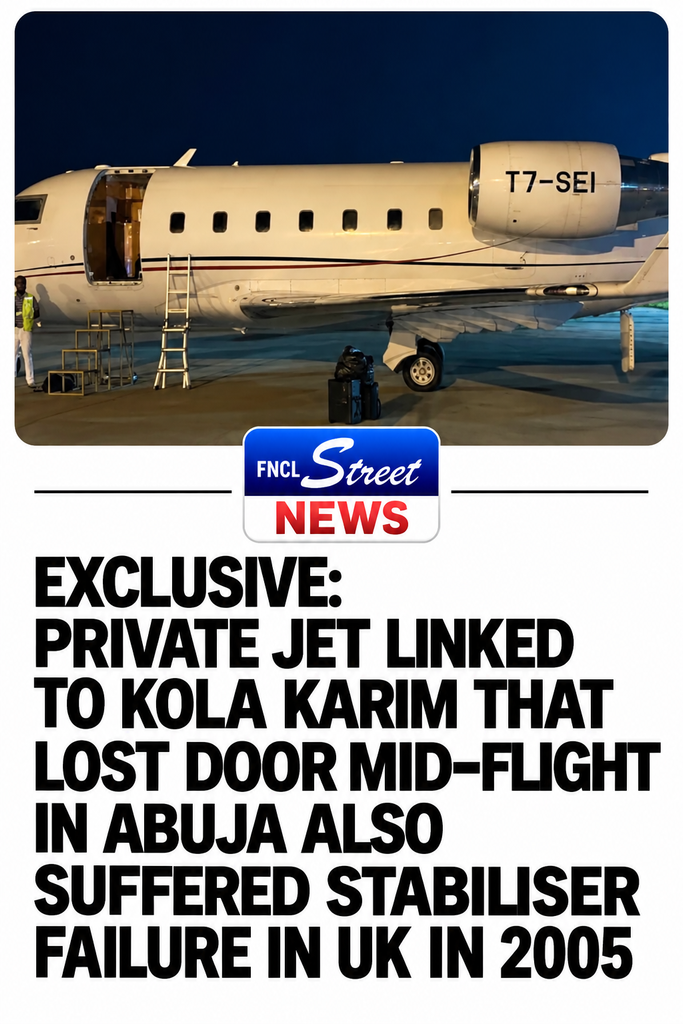
A private jet linked to Nigerian businessman Kola Karim, which lost its main cabin door shortly after taking off from Abuja, has a documented history of a serious mid-air flight-control malfunction in the United Kingdom in November 2005, according to aviation investigation records.
The aircraft, identified by its current registration as T7-SEI, is a Bombardier Challenger 604 associated with Shoreline Energy International, the Nigerian energy company linked to Karim. The aircraft recently made an emergency landing at the Nnamdi Azikiwe International Airport in Abuja after its crew reported a door problem during a flight bound for Lagos.
Records from the United Kingdom’s Air Accidents Investigation Branch (AAIB) document a serious incident involving a Bombardier Challenger 604 bearing the registration VP-BJM on November 11, 2005. The aircraft’s reported serial number matches that of the jet now registered as T7-SEI, according to aircraft-history information reviewed by Street News Reporters.
The 2005 incident occurred during a flight from Lagos to the United Kingdom. According to the official investigation report, the aircraft experienced failures involving its autopilot pitch-trim and stabiliser-trim systems, which affected the crew’s ability to maintain the desired flight attitude.
The stabiliser-trim system helps control an aircraft’s pitch, influencing whether its nose tends to move up or down. A malfunction can increase the physical effort required of pilots to maintain control, depending on the nature and severity of the failure.
Investigators documented that the stabiliser trim moved towards a nose-down position despite the crew’s attempts to command nose-up trim. The system eventually reached an almost full nose-down position, forcing both pilots to apply prolonged backward pressure on the control column to counteract the movement.
The crew diverted to London Heathrow Airport and landed with the aircraft’s flaps retracted. The commander made that decision because the crew believed deploying the flaps would substantially increase the control forces needed to maintain level flight under the circumstances.
The AAIB investigation traced the malfunction to contamination inside the Horizontal Stabiliser Trim Control Unit. Investigators concluded that moisture-related electrical contamination had caused shorting within the unit, affecting the system’s control channels.
The investigation also identified concerns about the installation of the control unit. The findings formed part of the technical assessment of why the system malfunctioned and how the failure affected the aircraft’s handling during the flight.
The November incident was not the only reported stabiliser-trim problem involving the aircraft during 2005. A separate review of aviation records indicates that the aircraft experienced several flight-control failures between July and November that year, including incidents that led to diversions and maintenance interventions.
In July 2005, the aircraft reportedly experienced a stabiliser-trim channel failure during cruise and diverted to Toulouse, France, where engineers examined the system. Another reported malfunction occurred in August, followed by a further incident in September involving the stabiliser trim, autopilot pitch trim and mach trim systems.
The November incident was particularly serious because the stabiliser trim continued moving towards a nose-down position despite the crew’s corrective commands. The series of reported events prompted technical scrutiny of the aircraft’s trim-control equipment and contributed to wider corrective measures affecting the relevant aircraft systems.
Following the investigation, Bombardier issued service information, while Transport Canada introduced airworthiness measures requiring inspections, cleaning or replacement of affected stabiliser-trim control units on specified Challenger aircraft. The aircraft’s serial number falls within the range covered by those measures, according to the published investigation material.
The aircraft subsequently continued operating under the registration VP-BJM for a number of years before appearing under the current registration T7-SEI. Aircraft records cited in recent reports indicate that it was acquired by Shoreline Energy International in May 2024.
The jet is operated by Triton Aviation and was identified as flight DWC052 during the Abuja-to-Lagos journey on Thursday, October 15, 2026. According to the reported incident timeline, the aircraft took off from Runway 22 at approximately 4:17 p.m. Coordinated Universal Time.
About three nautical miles from the airport, while climbing through approximately 3,000 feet, the crew reportedly issued a Mayday call after reporting that the aircraft’s door had opened in flight. Air traffic controllers directed the aircraft back to Abuja, and airport emergency personnel were placed on standby.
The aircraft landed safely at approximately 4:34 p.m. UTC. The Nigerian Safety Investigation Bureau subsequently confirmed that the door had been recovered and that an investigation had commenced. The bureau also reported that all nine people on board—three crew members and six passengers—were accounted for.
The circumstances surrounding the recent door separation remain under investigation. The 2005 stabiliser-trim malfunction involved a different aircraft system, and the historical incident does not, by itself, establish a technical connection with the door that detached over Abuja more than two decades later.
Nevertheless, the aircraft’s documented history has renewed attention on its maintenance records, previous technical problems and the importance of establishing whether all applicable airworthiness requirements and corrective measures were properly addressed throughout its operational life.
Investigators will need to determine the cause of the door separation, examine the relevant components and maintenance records, and establish whether mechanical, maintenance or operational factors contributed to the incident. Any conclusions about the aircraft’s present airworthiness should be based on the findings of the competent aviation authorities rather than its historical record alone.
Street News Reporters will continue to monitor the Nigerian Safety Investigation Bureau’s investigation into the Abuja incident and report any official findings concerning the cause of the door separation, the aircraft’s maintenance history and any safety recommendations issued by aviation authorities.
