



EXCLUSIVE: Patients Sleep On Mats In Dilapidated Taraba Hospital As ₦2.6bn 2026 PHC Capital Fund Remains Unspent

EXCLUSIVE: Patients Sleep On Mats In Dilapidated Taraba Hospital As ₦2.6bn 2026 PHC Capital Fund Remains Unspent
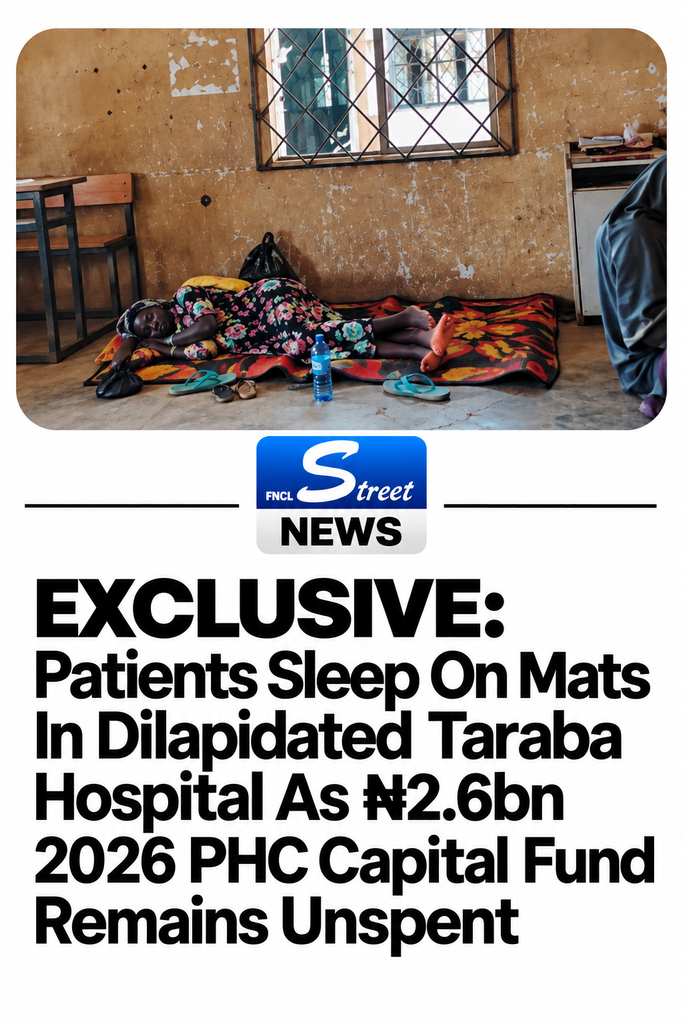
Patients receiving treatment at Jibu Hospital in Wukari Local Government Area of Taraba State, the home local government of Governor Agbu Kefas, are reportedly enduring deplorable conditions, with photographs showing patients lying on mats inside the health facility.
The photographs obtained by Street News Reporters show several parts of the hospital in a dilapidated condition, raising fresh concerns about the state of primary healthcare infrastructure and the utilisation of funds allocated for capital development in the sector.
One of the photographs shows a woman lying on a mat while receiving treatment, rather than being accommodated on a standard hospital bed.
The condition of the hospital has attracted particular attention because Wukari is Governor Kefas’ local government area, while his administration has reportedly approved about ₦80 billion for the construction of a flyover in the same area.
A review of Taraba State budget performance documents showed that ₦2.6 billion was budgeted for capital expenditure by the Primary Health Care Development Agency (PHCDA) in 2026.
However, as of the half-year period covered by the budget performance report, none of the ₦2.6 billion capital allocation had reportedly been spent.
The situation was also poor in the preceding year. In 2025, the Taraba State Government budgeted ₦2.8 billion for capital expenditure by the PHCDA, but the agency spent only about ₦139 million throughout the year, according to the budget performance records.
The figures mean that only a small portion of the capital allocation for primary healthcare was utilised in 2025, while no expenditure had been recorded from the 2026 allocation as of the period covered by the report.
The condition of Jibu Hospital has therefore raised questions about the prioritisation of healthcare spending in the state, particularly as patients continue to receive treatment in conditions that appear inadequate for a public health facility.
Residents who spoke about the situation expressed concern that the government could commit substantial funds to major infrastructure projects while existing healthcare facilities require urgent rehabilitation.
“Jibu Hospital is in Wukari, the governor’s own local government. Look at the situation of the hospital. Patients are sleeping on mats and the whole place is dilapidated. Yet the government is talking about spending ₦80 billion on a flyover in the same Wukari,” a source said.
Another source raised concerns about the administration’s approach to public contracting, alleging that large infrastructure projects could create opportunities for financial interests.
“You know that is the kind of contract that generates so much money for campaign,” the source alleged.
Beyond the allegations surrounding the flyover project, the budget performance figures raise broader questions about the implementation of capital projects within Taraba’s primary healthcare sector.
Primary healthcare facilities are expected to provide essential medical services, particularly for residents in rural and underserved communities. However, the photographs from Jibu Hospital show patients being treated in conditions that raise questions about the availability of adequate beds, equipment and other essential infrastructure.
The woman photographed receiving treatment on a mat provides one of the clearest illustrations of the challenges facing the facility.
Rather than being treated on a hospital bed, she was reportedly photographed lying on a mat on the floor while receiving medical care.
The wider condition of the hospital, as seen in the photographs, also points to deteriorating infrastructure and raises concerns about the ability of the facility to provide safe and adequate care for patients and working conditions for medical personnel.
The situation has renewed calls for greater attention to existing healthcare facilities, including the provision of functional buildings, hospital beds, medical equipment, drugs and other essential services.
While road infrastructure and other major capital projects remain important to development, the condition of Jibu Hospital highlights the need for government to balance such investments with urgent basic healthcare needs.
The low utilisation of PHCDA capital allocations in 2025 and the reported absence of expenditure from the 2026 allocation as of the half-year period have further intensified questions about how effectively funds earmarked for primary healthcare development are being implemented.
The situation at Jibu Hospital therefore presents a broader question for the Taraba State Government: whether available resources are being adequately directed toward improving the basic healthcare facilities used by residents, including those in the governor’s own local government area.
