




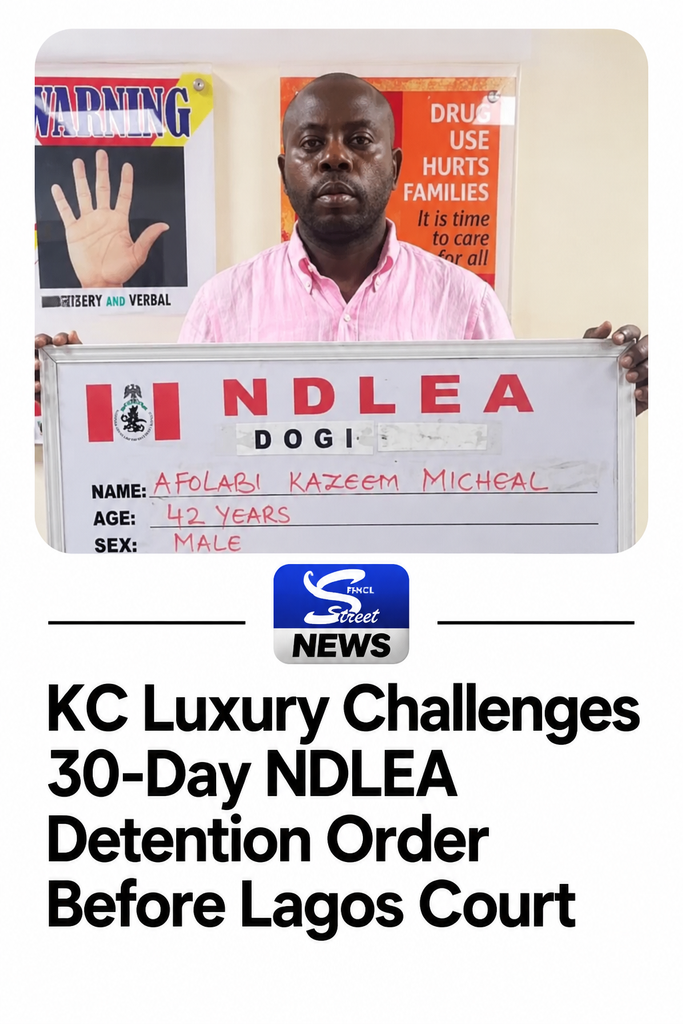
KC Luxury Challenges 30-Day NDLEA Detention Order Before Lagos Court
Detained social media influencer Afolabi Kazeem Michael, popularly known as KC Luxury, has asked the Federal High Court in Lagos to set aside or discharge an order authorising the National Drug Law Enforcement Agency (NDLEA) to detain him for 30 days.
Table Of Content
Kazeem’s lawyer, Abdulakeem Labi-Lawal, SAN, made the submission on Wednesday before Justice Friday Ogazi while challenging the legality of the detention order.
The court subsequently adjourned the matter until September 21, 2026, after parties agreed that proceedings should await the ruling of a sister court on an application challenging the court’s jurisdiction.
Defence Challenges 30-Day Detention
Labi-Lawal told the court that although the NDLEA obtained an order permitting it to detain Kazeem for 30 days to conduct further investigations, the order did not expressly require that he remain in custody throughout the entire period.
The senior lawyer argued that the agency could release his client on bail if it was satisfied with the progress of its investigation.
Kazeem is challenging the August 20, 2026 ex parte order authorising his detention in connection with allegations of drug trafficking.
In an application filed in Suit No. FHC/LAG/MISC/1199/2026, his lawyers asked the court to set aside or discharge the order, arguing that no criminal charge had been filed against him.
The defence maintained that the Federal High Court’s jurisdiction to try offences under the NDLEA Act is different from its power to order the pre-charge detention of a suspect.
The lawyers argued that the authority to try a person who has been formally charged with an offence should not automatically be interpreted as granting unlimited power to detain a suspect who has not yet been charged.
Lawyers Cite 14-Day Remand Limit
Kazeem’s legal team also challenged the 30-day detention period, arguing that it was inconsistent with provisions of the Administration of Criminal Justice Act (ACJA) 2015.
They relied on Sections 293 to 299 of the Act, particularly Section 296(1), which they said provides that an initial remand order should not exceed 14 days in the first instance.
The defence argued that where investigators require additional time to keep a suspect in custody, further judicial scrutiny should be required rather than a single, uninterrupted 30-day detention order.
The lawyers also asked the court to abridge the time for hearing their application and bring forward the date earlier fixed for review of the detention order.
They argued that continued detention could amount to an ongoing violation of Kazeem’s constitutional right to personal liberty and could render his legal challenge ineffective.
NDLEA Does Not Oppose Adjournment
Counsel to the NDLEA, Abu Ibrahim, did not oppose the defence application for an adjournment.
However, he clarified that the 30-day remand order was obtained in August before Kazeem subsequently approached the court seeking an order for his production.
Labi-Lawal also informed the court that the respondents had served their counter-affidavit on the defence team and that the applicants had five days to respond.
He urged Justice Ogazi to adjourn the matter to allow the parties sufficient time to respond to the processes already filed.
Justice Ogazi consequently adjourned the case until September 21, 2026, for further proceedings.
Background
Kazeem was arrested by NDLEA operatives on August 13 at the Murtala Muhammed International Airport in Lagos while preparing to travel to Paris.
His lawyers subsequently approached the court over his continued detention, arguing that he had spent more than 14 days in custody without being formally charged or arraigned.
The case followed the NDLEA’s seizure of 184.5 kilogrammes of cocaine concealed in a courier consignment, which the agency described as its biggest cocaine interception involving a logistics company.
The agency has alleged that the seizure is connected to a drug trafficking investigation involving Kazeem.
However, Kazeem is challenging the legality of his continued detention and has not been convicted of any offence.
