



EXCLUSIVE: HOW EBONYI GOVERNMENT SPENT OVER ₦53 BILLION IN BORROWED FUNDS ON ABANDONED AIRPORT PROJECT

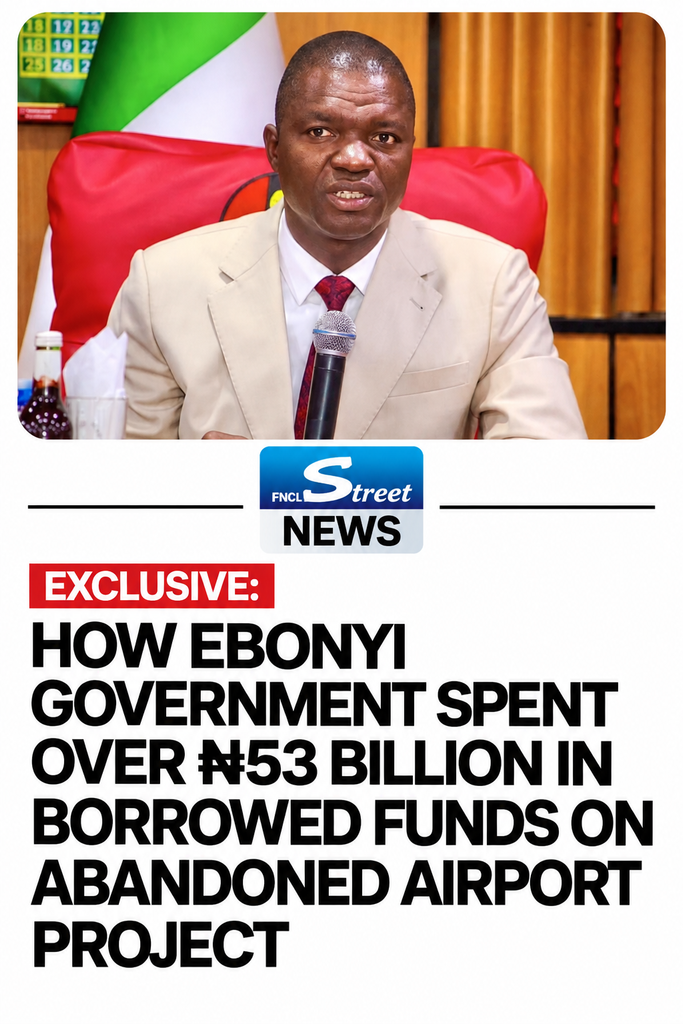
EXCLUSIVE: HOW EBONYI GOVERNMENT SPENT OVER ₦53 BILLION ON DORMANT AIRPORT PROJECT
The Chuba Okadigbo International Airport in Onueke, Abakaliki, Ebonyi State, has come under scrutiny over more than ₦53 billion reportedly spent on its construction and subsequent rehabilitation, despite the facility recording limited flight activity since its commissioning.
The airport was conceived and constructed under the administration of former Ebonyi State Governor David Umahi, now Minister of Works, and was officially inaugurated on May 26, 2023, by former President Muhammadu Buhari.
Weeks before the formal commissioning, on April 26, 2023, Umahi had celebrated the touchdown of two Air Peace flights as part of the symbolic launch of the airport. However, more than three years after its inauguration, the facility has reportedly remained largely inactive, raising questions about the economic returns from the huge public expenditure.
A visit to the airport on Tuesday, September 8, 2026, found the facility largely deserted, with empty access roads stretching from the Airport Junction along the Onueke road to the terminal gates.
At the security checkpoint, security personnel reportedly prevented visitors and journalists from entering the facility, saying they had received directives restricting unauthorised access.
One security guard, who spoke anonymously, said workers only come to the airport on the rare occasions when a chartered aircraft is scheduled to land.
Sources familiar with the airport’s operations also claimed that the facility had recorded fewer than 55 total aircraft landings, including commercial and private chartered flights, since its establishment. The claim could not independently be verified from official flight records in the report.
The financial burden of the project increased further after structural problems were reportedly identified with the concrete runway. While the former Umahi administration was said to have spent more than ₦36 billion in borrowed funds on the airport, the administration of Governor Francis Nwifuru subsequently committed another ₦17.3 billion to major remedial work, including resurfacing the runway with asphalt.
Governor Nwifuru had previously spoken about technical problems inherited at the facility, including alleged runway defects that affected aircraft and discouraged commercial airlines from operating there.
According to Nwifuru, the runway was uneven and was damaging aircraft tyres. He said attempts to address the problem through the filling of expansion joints did not resolve the issue, prompting consultations with the Federal Ministry of Aviation.
The governor said aviation officials advised the state to undertake additional technical work, including certification, installation of tie-rods and asphalt surfacing. He also acknowledged that abandoning the facility was not considered an option because of the substantial amount already invested in the project.
Despite efforts to attract passengers, including a 50 percent subsidy on airfares introduced by the Nwifuru administration, sources claimed that commercial flights had struggled to attract sufficient passengers, with fewer than 20 passengers reportedly boarding some flights.
An insider alleged that chartered flights to the airport were mainly associated with trips involving former Governor Umahi and his family or the current governor. The claim could not be independently verified.
The administration also announced plans to establish a state-owned airline. During his January 2026 New Year address, Governor Nwifuru said the state had procured three aircraft and expected them to arrive before the end of that month.
However, nine months after the announcement, the aircraft had reportedly not arrived, prompting questions from members of the public over the status of the proposed fleet.
Sources also alleged that state officials were defrauded during negotiations to acquire the aircraft. The allegation remains unproven, while government officials had not publicly provided details on the status of the procurement or the funds involved at the time of the report.
Barrister Gerald Moses Ede, a legal practitioner, criticised the airport project as an economic misadventure, arguing that the state should have prioritised projects capable of generating employment and stimulating economic activity.
Ede questioned the rationale for investing billions of naira in an airport in a state that, according to him, lacks sufficient industrial and commercial activity to generate the passenger traffic needed to sustain regular air services.
He argued that Ebonyi should prioritise factories, power infrastructure and commercial hubs, saying industrialisation would create businesses, attract people into the state and ultimately generate demand for air transportation.
Businessman Solomon Ugochukwu similarly argued that the funds committed to major projects such as the airport could have been invested in industries and power infrastructure to stimulate broader economic development.
According to Ugochukwu, the absence of significant industrial activity means that Ebonyi’s economy remains heavily dependent on government employment, making it difficult for an airport to attract enough passengers to operate sustainably.
The concerns surrounding the airport come against the backdrop of widespread poverty and infrastructure challenges in parts of Ebonyi State.
Data from the National Bureau of Statistics cited in the report places Ebonyi among Nigeria’s poorest states, with a poverty headcount rate of 79.76 percent. Some rural communities also continue to face inadequate infrastructure, including poor road networks.
The report further highlighted allegations by activists that residents and critics who question government spending face intimidation and pressure from state authorities.
Activist Godwin Onyekachi claimed that critical voices in Abakaliki had been subjected to surveillance and harassment, alleging that some residents had become reluctant to publicly question government policies because of fear of reprisals.
He also alleged that political influence and material inducements had weakened opposition from some institutions and civil society groups, arguing that this had reduced public scrutiny of government spending.
Street News Reporters’ efforts to obtain a response from the Ebonyi State Commissioner for Information and State Orientation, Chief Ikeuwa Omebeh, were reportedly unsuccessful. Calls to his phone were not answered, while a text message seeking clarification on issues raised in the report had also not received a response as of the time of filing.
The controversy over the Chuba Okadigbo International Airport therefore centres on whether the more than ₦53 billion reportedly committed to the project has delivered sufficient public and economic value, particularly in a state facing significant poverty, infrastructure deficits and limited industrial activity.
