



ENUGU: HOW PETER MBAH GOVERNMENT SPENT ₦23 BILLION OUTSIDE APPROVED BUDGETARY PROVISIONS

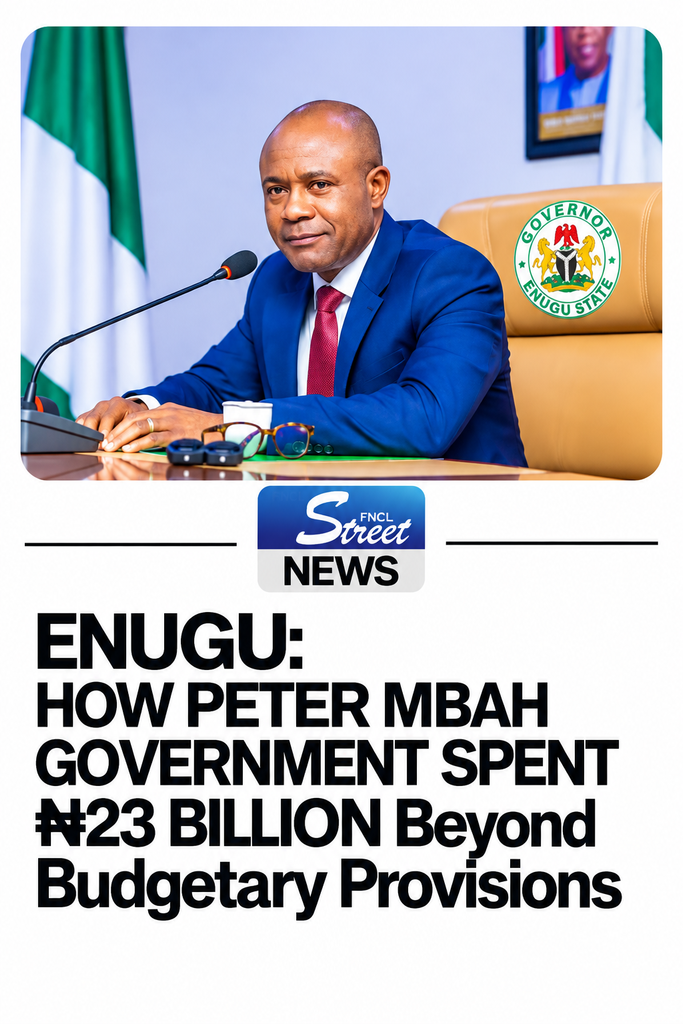
ENUGU: HOW PETER MBAH GOVERNMENT SPENT ₦23.83 BILLION ABOVE APPROVED BUDGETARY PROVISIONS
The Governor Peter Mbah-led Enugu State Government spent ₦23.83 billion above approved capital expenditure provisions in 2025, according to findings contained in the state Auditor-General’s report.
The report raised concerns over the financial activities of ministries, departments and agencies (MDAs), following a review of the state’s financial statements which showed that several capital projects were either executed without revised budgetary provisions or exceeded the amounts allocated to them.
According to the report, the affected projects recorded actual expenditure of ₦26.46 billion, while only ₦2.64 billion had been provided for them in the revised 2025 budget. The difference resulted in ₦23.83 billion being classified as expenditure above approved provisions.
Some of the largest discrepancies were recorded under the Office of the Secretary to the State Government (SSG), where billions of naira were spent on projects that either exceeded their approved allocations or had no corresponding revised budgetary provision.
For instance, the SSG’s office spent ₦2.382 billion on the purchase of utility vehicles for MDAs despite a revised budgetary provision of ₦480 million. The expenditure therefore exceeded the approved allocation by ₦1.902 billion.
The office also spent ₦52.02 million on furnishing and equipping the new Executive Council Secretariat building against a revised provision of ₦30 million, resulting in an excess expenditure of ₦22.02 million. Another ₦270 million was reportedly spent on utility vehicles despite no revised provision for the project.
The largest single expenditure flagged by the Auditor-General was ₦8.98 billion spent as a financial commitment for the preparation of a Competent Person Report by the Office of the Secretary to the State Government. The report stated that there was no revised budgetary provision for the expenditure, meaning the entire ₦8.98 billion was classified as excess expenditure.
The Ministry of Agriculture and Agro-Industrialization also featured prominently in the findings. The ministry reportedly spent ₦4.004 billion on establishing new abattoirs and upgrading four existing facilities at Ogbete, Garriki, Emene and Abakpa, despite having no revised budgetary provision for the project.
It also spent ₦1.398 billion on agricultural consulting without a corresponding revised provision. The two expenditures amounted to approximately ₦5.4 billion.
The Office of the Executive Governor was similarly flagged for several expenditures. According to the report, ₦3.75 billion was spent on flood control and road rehabilitation without a revised budgetary provision.
The office also spent ₦330.41 million on the construction, reconstruction and renovation of offices and lounges at Government House, while another ₦227.5 million was spent on replacing damaged waste bins across the metropolis.
Other expenditures attributed to the office included ₦27.59 million for communication equipment for security personnel, ₦25 million for computer software development and ₦11.19 million for the rehabilitation of the governor’s office and Executive Council Hall. The Auditor-General’s report said these projects had no revised budgetary provisions.
The Ministry of Transport was also cited for exceeding its approved allocation for the procurement of 2,000 taxis under the Youth Empowerment Scheme. While ₦2 billion was provided in the revised budget, the ministry spent ₦2.3 billion, resulting in an excess of ₦300 million.
The Enugu State Internal Revenue Service was another agency highlighted in the report. It reportedly spent ₦322.62 million on office equipment, including laptops, Samsung Galaxy devices, printers and photocopiers, against a revised provision of ₦75.05 million, representing an excess of ₦247.57 million.
The agency further spent ₦168.54 million on installing a high-capacity solar energy system and alternative power supply for some outstation offices, despite a provision of ₦50 million. The expenditure exceeded the allocation by ₦118.54 million.
The Auditor-General also listed ₦410.25 million spent on the construction and equipping of the agency’s training centre and ₦20.05 million on four buses and four Hilux vans for zonal offices, with the report stating that no revised provisions were recorded for the projects.
Other MDAs were also affected by the findings. The State Science Technical and Vocational Schools Management Board reportedly spent ₦255.63 million on furniture for staff rooms, libraries, zonal offices and headquarters without a revised budgetary provision.
The Post Primary Schools Management Board spent ₦817.22 million on renovating 50 public secondary schools across the state without a corresponding revised provision, while the Enugu State Marketing Company incurred ₦644.70 million on the construction of farm estates across the state.
The state judiciary also recorded expenditures flagged by the Auditor-General, including ₦21.62 million on additional hardware for the digitisation and automation of the High Court of Justice and ₦43.37 million on renovating the Justice A.I. Umezuluike Auditorium.
Beyond capital expenditure, the report examined pension and gratuity payments made by the state government during the year. It stated that 868 files belonging to retired and retiring civil and public servants were submitted in 2025 for verification, certification and the computation or recomputation of retirement benefits.
According to the Accountant-General’s report, Enugu State spent ₦9.16 billion on pensions during the year, compared with an approved budget of ₦8.113 billion. This represented 112.92 per cent performance against the budgeted provision.
Gratuity payments, however, were significantly below the amount budgeted. The state spent ₦1.92 billion on gratuities against a budgetary provision of ₦15.104 billion, representing only 12.73 per cent performance.
The Auditor-General’s findings raise questions about compliance with approved budgetary appropriations and the extent to which government agencies committed public funds outside the provisions contained in the revised 2025 budget.
The report’s identification of ₦23.83 billion in capital expenditure above approved provisions highlights a substantial gap between Enugu State’s revised capital budget and actual spending on several projects during the year.
