



‘IF EL-RUFAI ENABLED KILLINGS IN KADUNA SOUTH, MILITARY WAS COMPLICIT’ — EX-GOC ALI-KEFFI CHALLENGES DEFENCE MINISTER MUSA

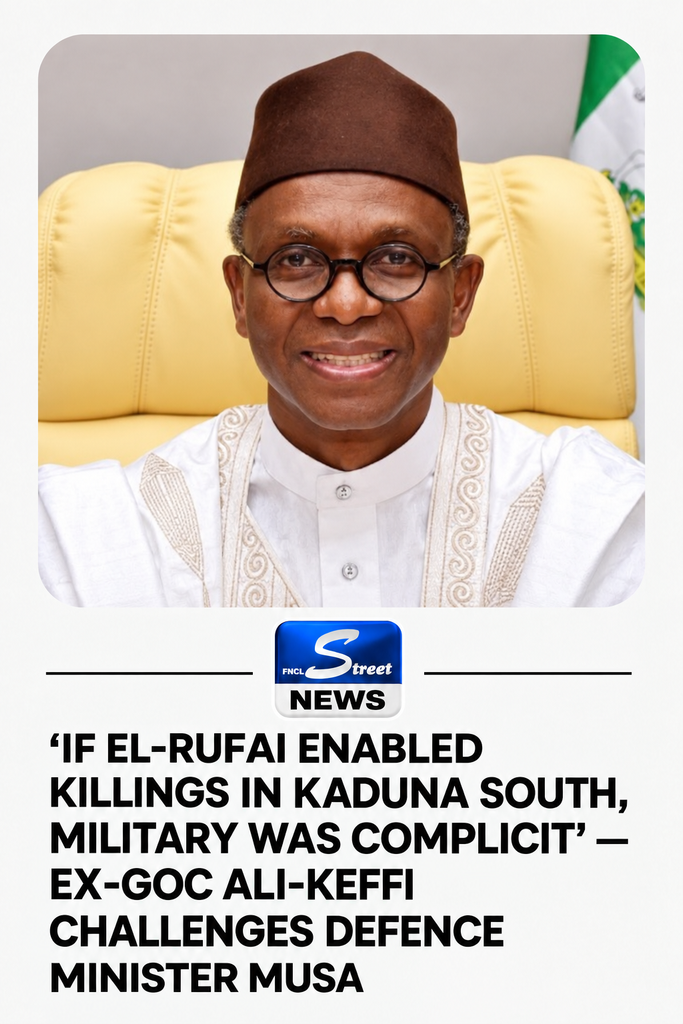
‘If El-Rufai Enabled Killings Of Kaduna South Residents, Military Was Complicit’ — Ex-GOC Ali-Keffi Challenges Defence Minister Musa
Retired Nigerian Army Major General Danjuma Hamisu Ali-Keffi has challenged Defence Minister Christopher Gwabin Musa to explain how former Kaduna State Governor Nasir El-Rufai could have enabled killings in the state without the involvement or failure of the military and other security agencies.
Ali-Keffi, who served as General Officer Commanding (GOC) 1 Division of the Nigerian Army between March and August 2021, said the military’s operational structure during his tenure made it impossible for the former governor to directly control military operations in several parts of Kaduna State.
The retired general made the comments in an interview with Street News Reporters while responding to allegations made by Musa concerning El-Rufai’s handling of insecurity in Kaduna.
On Thursday, Musa said residents of Southern Kaduna remained deeply affected by killings recorded in the area during El-Rufai’s eight-year tenure as governor.
Speaking on Channels TV, the Defence Minister contrasted El-Rufai’s administration with that of incumbent Governor Uba Sani, whom he credited with making efforts to bridge divisions between communities in Northern and Southern Kaduna.
“When the incumbent Kaduna State governor, Uba Sani came, he showed a huge difference, we know how it was when El-Rufai was there,” Musa said.
“El-Rufai did a lot of toxic things in Kaduna State, divided the state, in that if you are from the South, you cannot move to the North. Those ones from the North were moving to the South but Governor Uba has resolved all that. It is not 100% but he is making genuine efforts at uniting the state.”
Musa was subsequently asked whether residents of Southern Kaduna remained unhappy with El-Rufai over events that occurred during his administration.
The minister said the sentiment went beyond unhappiness, alleging that some residents believed the former governor deliberately planned the killing of their people.
“If there is anything worse than unhappy, it would be it. We can never be happy with someone who has deliberately planned for the killing of our people. If you see some of his videos, you will see that he was arrogant that he paid bandits, he did this, he did that, he did not hide it,” Musa said.
The minister did not provide specific details during the interview to substantiate his allegation that El-Rufai deliberately planned killings in Southern Kaduna.
El-Rufai served as Kaduna State governor from 2015 to 2023, a period marked by communal violence, bandit attacks, killings and displacement in several parts of the state, particularly Southern Kaduna.
However, Ali-Keffi rejected the suggestion that El-Rufai could have directly controlled military operations or facilitated killings without the knowledge or failure of security agencies operating in the affected areas.
He said he never received any instruction from El-Rufai to kill civilians, halt military operations or allow armed groups to operate.
According to Ali-Keffi, 1 Division’s area of responsibility during his tenure covered parts of Kaduna, Kano, Jigawa and Niger states, as well as four local government areas in Yobe State.
He noted that much of Southern Kaduna fell outside the operational control of 1 Division and was instead under the 3 Division/Operation Safe Haven structure.
He therefore questioned how El-Rufai could have personally enabled killings in areas where the military and other security agencies had operational responsibilities.
“How is it possible for an executive governor… except with the military and security agency [complicity]… certain things will not happen without secret agencies compromising,” Ali-Keffi said.
The retired general said allegations that a governor deliberately facilitated attacks must also raise questions about the security and intelligence agencies responsible for preventing such incidents.
Ali-Keffi also denied that El-Rufai ever instructed him or his commanders to refrain from conducting operations against criminal groups.
He recalled that troops under his command carried out clearance operations around Birnin Gwari, Sabon Birni, Dogon Dawa and Kamuku.
According to him, he regularly contacted El-Rufai before major operations, not to seek permission, but to ask the governor to warn civilians and local authorities to stay away from areas where military operations were scheduled.
Ali-Keffi recalled that El-Rufai initially rejected the request, arguing that anyone found inside certain forests was likely to be complicit.
“No, General, I will not do that. Anybody who is in that forest is complicit,” Ali-Keffi recalled El-Rufai as saying.
The former GOC said he subsequently explained that the military had a responsibility to minimise civilian casualties and collateral damage, regardless of its assessment of people living in or around areas occupied by criminal groups.
He said El-Rufai eventually understood the military’s position and did not attempt to stop the operations.
Ali-Keffi also highlighted the role of Samuel Aruwan, who served as Kaduna State Commissioner for Internal Security and Home Affairs under El-Rufai.
According to the retired general, Aruwan played a crucial role in providing intelligence to the military and maintaining regular communication with commanders.
Ali-Keffi said intelligence was sometimes received hourly and was used to guide military operations against bandits and other criminal groups.
He also claimed that military operations during his tenure helped keep major roads, including the Kaduna-Birnin Gwari-Tegina highway and Kaduna-Abuja Road, largely free from criminal attacks.
According to him, the security situation deteriorated after he left command.
The retired general said two brigadier generals who served as garrison commanders during his tenure could also attest to the absence of political interference in military operations.
He said the officers, who were later promoted to major general, could confirm that neither he nor his commanders received instructions from El-Rufai to target civilians or abandon operations against criminal groups.
Ali-Keffi said he was particularly disappointed by Musa’s comments because of his previous relationship with the Defence Minister, whom he described as his “erstwhile friend.”
He maintained that while he did not support everything El-Rufai did during his administration, allegations concerning the former governor’s role in insecurity must be supported by evidence.
The retired general recalled that a property he personally owned at the National Eye Centre in Mando was demolished during El-Rufai’s administration but said the incident did not influence his professional relationship with the former governor.
Ali-Keffi said personal grievances should not be used as a basis for making unsupported accusations.
“I would not have said these things I am saying but it is very unfair for the Minister of Defence Christopher Musa to have gone after El-Rufai, I don’t support some of the things that El-Rufai did, no.”
He said his position was based on what he witnessed while serving as a military commander in the region.
Ali-Keffi further argued that El-Rufai’s conduct during his tenure should be assessed against the actual operational structure of Nigeria’s security agencies rather than through political accusations.
He insisted that if the former governor had indeed facilitated killings while military operations were ongoing, questions would also have to be asked about the security agencies responsible for preventing such attacks.
“Injustice is injustice and I stand for justice,” Ali-Keffi said.
