



BAYELSA PDP ACCUSES DIRI OF SECRETLY WORKING AGAINST TINUBU’S 2027 RE-ELECTION, QUESTIONS GOVERNOR’S LOYALTY TO APC

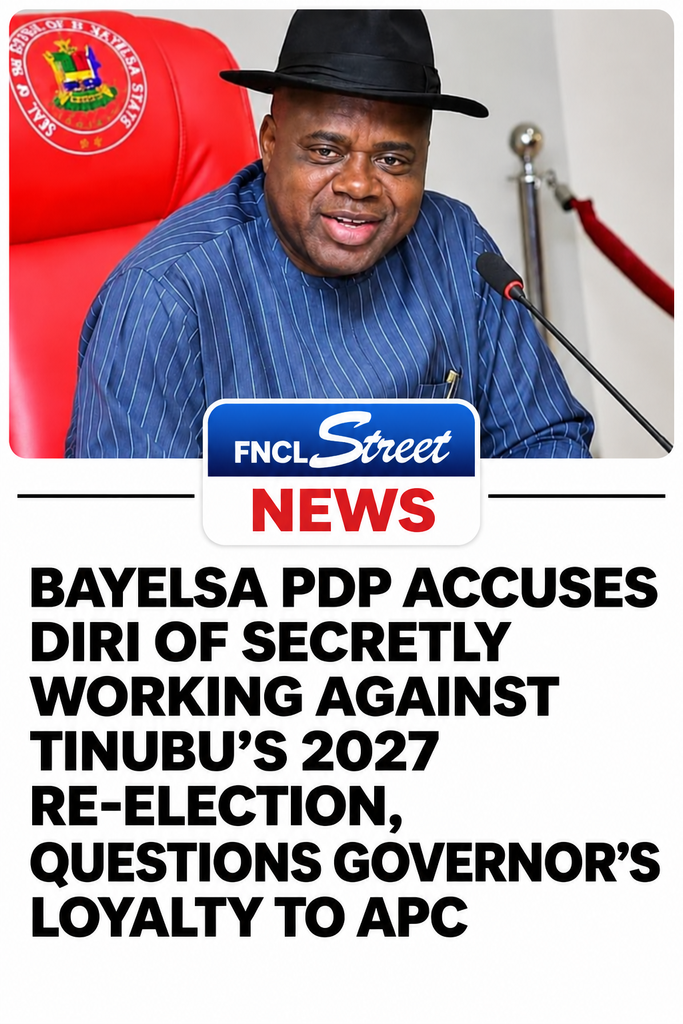
The Bayelsa State chapter of the Peoples Democratic Party (PDP) has questioned Governor Douye Diri’s commitment to President Bola Tinubu’s 2027 re-election bid, accusing the governor and the state leadership of the All Progressives Congress (APC) of engaging in activities that could undermine the President’s political ambition.
The party’s position was made public on Sunday, November 1, 2026, amid an escalating political disagreement between the PDP and APC in Bayelsa over who is genuinely supporting Tinubu’s second-term ambition.
In a statement signed by its State Publicity Secretary, Hon. Ikaebimo Mark, the PDP challenged the Bayelsa APC chairman, Warman Weri Ogoriba, to respond to allegations raised by the party’s state chairman, George Turnah, rather than resorting to personal attacks and political distractions.
The opposition party maintained that questions concerning Governor Diri’s political activities, the administration’s performance and the state government’s relationship with the ruling party at the federal level deserved clear and verifiable answers.
The PDP specifically accused Diri of secretly engaging in anti-party activities despite public claims that he was supporting Tinubu’s re-election campaign.
It alleged that the governor was paying monthly stipends to thousands of former PDP officials across ward, local government and state levels who belong to the Kabiru Tanimu Turaki faction of the PDP.
The party further claimed that some members of the group were openly aligned with the Allied Peoples Movement (APM) and were mobilising support for the presidential ambition of Oyo State Governor, Seyi Makinde.
The allegations, according to the PDP, raised questions about whether Diri and the Bayelsa APC leadership were genuinely committed to Tinubu’s 2027 political project.
The party also challenged Ogoriba to provide evidence of his own commitment to the President’s re-election, questioning why the APC chairman had allegedly failed to consistently issue public statements, make media appearances or openly mobilise support for Tinubu.
It argued that the APC leadership should demonstrate its support through visible political activities rather than relying on public assurances.
The PDP’s latest position followed comments by Turnah, who had earlier questioned Diri’s participation in activities organised to promote Tinubu’s second-term ambition.
While addressing party members at the PDP secretariat on Friday, October 30, Turnah asked whether the Bayelsa governor attended the inauguration of the APC Presidential Campaign Council in Abuja or participated in the presidential campaign flag-off in Kaduna.
He also questioned whether the governor had visited communities across Bayelsa to mobilise support for Tinubu or whether campaign billboards had been erected to promote the President’s re-election.
Turnah argued that there was little visible evidence of the governor’s involvement in the campaign and maintained that the PDP was among those actively supporting Tinubu’s political ambition.
However, the Bayelsa APC chairman rejected the allegations, describing them as baseless and insisting that Diri had demonstrated his support for the President through public statements and political engagements.
Ogoriba maintained that the governor was among those at the forefront of Tinubu’s re-election campaign and dismissed suggestions that he was not supporting the City Boys Movement, a political support group associated with the President.
The APC chairman also claimed that Diri had supported the movement in different ways, including attending some of its activities.
The disagreement has therefore developed into a public exchange between the two parties, with the PDP questioning the governor’s loyalty and the APC insisting that his political actions demonstrate support for Tinubu.
Beyond the disagreement over the President’s re-election, the PDP also accused the Diri administration of failing to adequately address poverty, hunger, insecurity, healthcare, education and infrastructure challenges in Bayelsa State.
It argued that the state government should provide verifiable information about public spending, the management of state assets and the delivery of essential services.
The opposition party insisted that these issues were matters of public interest and should not be dismissed as political attacks.
It urged the APC-led government to respond with facts and figures, adding that political disagreements should not prevent residents from demanding accountability from elected officials.
The latest accusations come amid broader political realignments ahead of Nigeria’s 2027 general elections, with parties and political support groups positioning themselves around presidential and state-level contests.
Governor Diri, who defected from the PDP to the APC in 2025, has become an important figure in the political calculations surrounding Bayelsa State and the ruling party’s efforts to consolidate its presence in the South-South region.
Former Bayelsa Governor and Senator representing Bayelsa West, Henry Seriake Dickson, has also criticised Diri’s defection, accusing him of handing the state to the APC despite the PDP’s efforts to secure his governorship victory through the courts.
Dickson has since rallied support for the Nigeria Democratic Congress (NDC) and its presidential candidate, Peter Obi, further illustrating the political divisions among influential figures in the state.
Despite the competing claims, neither the PDP’s allegations of secret anti-party activities nor the APC’s assurances about Diri’s commitment to Tinubu’s re-election have been independently established through publicly presented evidence.
The controversy has placed renewed attention on the political relationship between the Bayelsa Government House and the APC leadership as preparations for the 2027 elections continue.
Street News Reporters will continue to monitor the political developments in Bayelsa, including responses from Governor Douye Diri and the APC leadership, as well as further evidence concerning the allegations of secret political activities and support for Tinubu’s re-election.
