



‘HE SHOULD BE PRIME MINISTER, NOT CHIEF APOLOGISER’: KEMI BADENOCH ATTACKS BURNHAM OVER PROPOSED SLAVERY APOLOGY

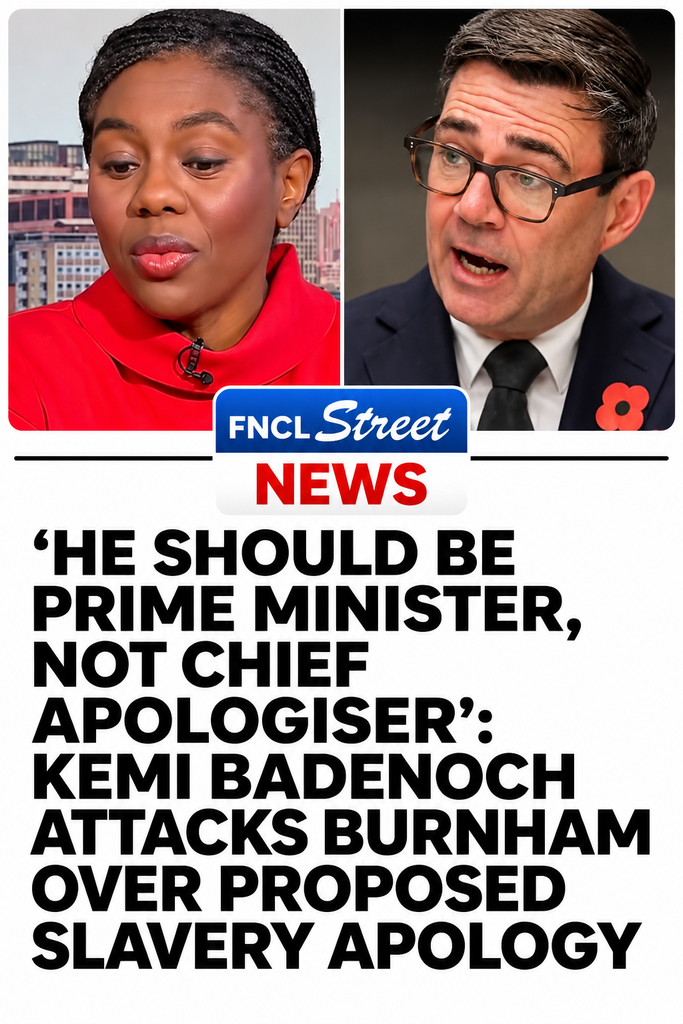
The leader of Britain’s Conservative Party, Kemi Badenoch, has criticised Prime Minister Andy Burnham over his willingness to consider a formal apology for the United Kingdom’s role in the transatlantic slave trade, saying he should focus on defending Britain’s interests rather than apologising for historical events.
Badenoch made the remarks on Sunday, November 1, 2026, during an interview with Sky News, arguing that Burnham’s position could place unnecessary pressure on King Charles III ahead of the forthcoming Commonwealth Heads of Government Meeting (CHOGM) in Antigua and Barbuda.
The controversy followed Burnham’s recent declaration that the British Government was open to discussing a formal apology to countries and communities affected by the transatlantic slave trade.
In an article published in The Guardian, Burnham described the slave trade as a brutal violation of human rights and said his government was willing to engage in structured discussions with affected countries.
He also expressed personal sorrow and regret over the suffering endured by millions of enslaved Africans, while making clear that he did not support financial reparations that would make present-day British citizens financially liable for historical events.
Burnham’s position has attracted renewed attention because it represents a willingness to consider a formal state apology, an issue that has remained contentious in Britain’s relationship with Caribbean and other Commonwealth countries.
Reacting to the Prime Minister’s comments, Badenoch warned that his intervention could create difficulties for the King, who is expected to address the legacy of slavery during the Commonwealth summit.
She argued that Burnham should not take positions on the matter that could place the monarch under pressure to make a similar declaration.
Speaking to Sky News presenter Fraser Nelson, Badenoch said the Prime Minister should concentrate on strengthening relationships among Commonwealth countries, improving security cooperation and expanding economic partnerships.
She added that Britain should focus on defending its national interests rather than allowing discussions about apologies and reparations to dominate the summit.
Badenoch further criticised Burnham’s handling of the issue, accusing him of making statements without adequately considering their wider implications.
She also referred to previous remarks attributed to the Prime Minister concerning Scottish independence, national security and the possibility of closer relations with the European Union, arguing that his comments had repeatedly created political difficulties.
When asked what she wanted to see from the Prime Minister, Badenoch said he should be defending Britain rather than acting as what she described as the country’s chief apologiser.
The Conservative leader also maintained that Britain had already acknowledged its historical involvement in the slave trade, pointing to former Prime Minister Tony Blair’s 2007 expression of deep sorrow and regret over the country’s role in slavery.
She argued that another formal apology was unnecessary and warned that renewed discussions could encourage demands for financial compensation.
In a separate statement, Badenoch questioned whether Caribbean countries seeking an apology from Britain would also demand similar acknowledgements from descendants of African kingdoms, rulers and merchants who participated in the capture and sale of enslaved people.
She argued that the history of slavery involved participants from different continents and regions and should be addressed in its entirety rather than focusing exclusively on Britain’s involvement.
Badenoch also rejected calls for reparations, arguing that British taxpayers living today should not be held financially responsible for events that occurred generations before they were born.
However, Burnham’s position has received support from members of his government, who have maintained that considering a formal apology does not mean accepting financial liability for historical slavery.
Chancellor John Healey defended the Prime Minister’s willingness to discuss an apology, saying it was important to acknowledge the brutality of the slave trade while maintaining the government’s opposition to financial reparations.
Chief Secretary to the Treasury Emma Reynolds also said the government was open to considering a formal apology but maintained that financial compensation was not under consideration.
The debate comes as Caribbean leaders continue to demand greater recognition of the historical consequences of slavery, including formal apologies and reparatory measures.
Several Caribbean governments have argued that the transatlantic slave trade contributed to long-term economic and social inequalities that continue to affect their countries.
Barbados Prime Minister Mia Mottley has been among the prominent voices advocating reparatory justice, while other Caribbean leaders have also renewed calls for Britain to acknowledge its historical role.
King Charles is expected to address the issue during the Commonwealth summit in Antigua and Barbuda. Buckingham Palace has indicated that the monarch will confront difficult aspects of the past with honesty, although he is not expected to announce a formal apology on behalf of the British Government.
The disagreement has exposed divisions within British politics over how the country should address its colonial history, the demands of former colonies and the question of whether historical acknowledgement should be accompanied by financial reparations.
While Badenoch insists that the government should prioritise present-day national interests, Burnham has maintained that Britain should remain open to dialogue with countries affected by the slave trade.
Street News Reporters will continue to monitor the debate, including the British Government’s position on a formal apology, reactions from Caribbean leaders and King Charles III’s address at the Commonwealth summit.
