



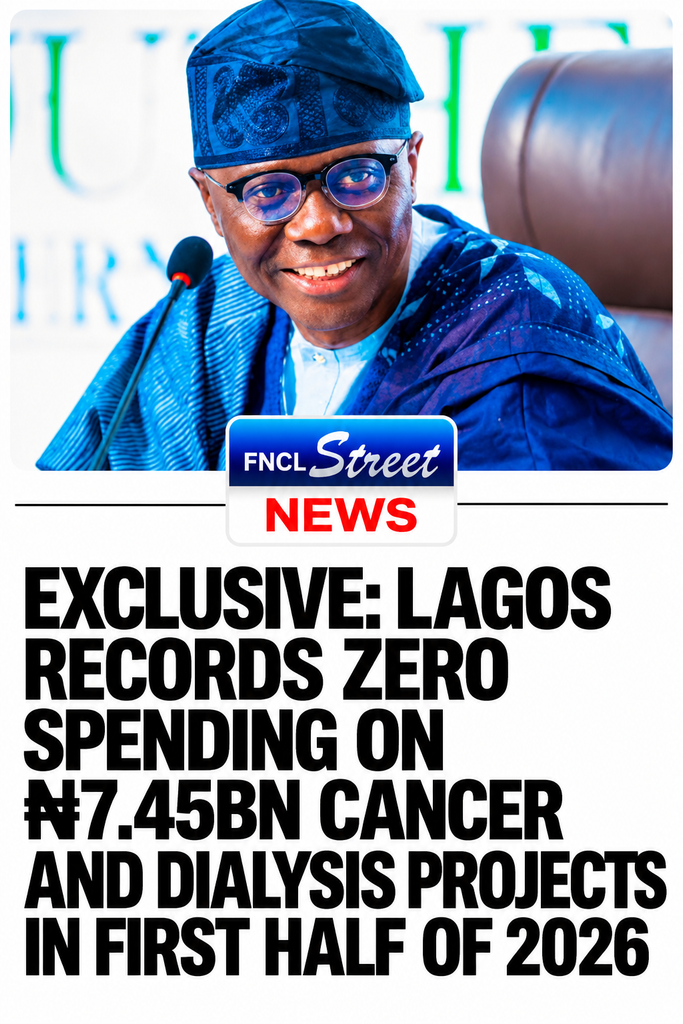
EXCLUSIVE: LAGOS RECORDS ZERO SPENDING ON ₦7.45BN CANCER AND DIALYSIS PROJECTS IN FIRST HALF OF 2026

The Lagos State Government recorded zero expenditure on two major cancer and dialysis-related projects with a combined budget allocation of ₦7.45 billion during the first six months of 2026, according to the state’s second-quarter Budget Performance Report.
The figures raise questions about the implementation of planned investments in specialist healthcare in Nigeria’s commercial capital, where cancer patients and people living with kidney failure face substantial treatment costs and challenges accessing specialised medical services.
According to the budget report covering January to June 2026, the state allocated ₦7 billion to a project for establishing dialysis and cancer dialysis centres across the three senatorial districts, alongside a proposed upgrade to a university teaching hospital.
However, the report showed no expenditure against the project as of June 30, 2026. The full ₦7 billion allocation remained unspent in the year-to-date expenditure column, with no second-quarter performance recorded for the project.
The project was listed under the Ministry of Economic Planning and Budget rather than directly under a health ministry or a specifically identified hospital. The report did not state the locations of the proposed centres, provide implementation milestones or explain why no expenditure had been recorded during the period.
In addition to the proposed centres, the Lagos State Government allocated ₦450 million for the purchase of 10 pieces of equipment for its State Cancer Control programme. The budget performance report also showed zero expenditure on this project by the end of June.
Another healthcare-related project, involving the purchase of equipment for healthcare facilities under the Saving One Million Lives Programme for Results (SOML P for R), had an allocation of approximately ₦2.39 billion, with no expenditure recorded during the period under review.
The figures have drawn attention to the difference between announcing budgetary allocations for healthcare infrastructure and translating those allocations into operational facilities, equipment and services for residents.
Cancer treatment in Lagos can impose significant financial pressure on patients and their families. Treatment may involve surgery, chemotherapy, radiotherapy, diagnostic imaging, laboratory tests and medicines, with costs accumulating throughout the course of care.
A study examining the distribution of cancer screening and treatment services in Lagos over a 10-year period found that only about five per cent of the assessed health facilities provided cancer screening or treatment services. The researchers also identified gaps in patient records and service documentation that could affect healthcare planning and resource allocation.
Another study involving patients attending tertiary oncology clinics in Lagos found that many relied on out-of-pocket payments to cover essential medical expenses. About 90 per cent of respondents reported paying for drugs or medicines themselves, while 91.7 per cent reported out-of-pocket expenditure on laboratory tests.
Relatives were identified as a major source of financial support for many patients, highlighting the burden cancer treatment can place on households. Patients unable to raise the necessary funds may delay treatment or struggle to complete prescribed care.
The financial challenges have been illustrated by individual cases in which patients have reportedly been unable to proceed with chemotherapy because of the cost. In 2025, a Lagos cancer patient was reported to have said she could not continue with chemotherapy after being told that the treatment would cost ₦2.5 million.
Although Lagos has specialist oncology services at facilities such as the Lagos University Teaching Hospital and the Lagos State University Teaching Hospital, the availability of these institutions does not eliminate financial barriers or guarantee timely access to treatment for every patient.
The proposed cancer and dialysis centres could expand access to specialist care if they are funded, equipped, staffed and made operational. However, the budget report does not establish whether alternative funding sources were used, whether implementation activities occurred outside the recorded expenditure or whether other arrangements were made to deliver the planned services.
The concerns also extend to dialysis services, which many patients with kidney failure require repeatedly to remain alive. The cost of regular treatment can place severe pressure on patients who must attend multiple sessions every week.
In March 2026, reports indicated that dialysis sessions at many private healthcare facilities cost between ₦50,000 and ₦80,000, with some patients requiring two or three sessions weekly. At those rates, the recurring cost can consume a substantial portion of a household’s income.
Questions have also previously been raised about the condition of public dialysis infrastructure in Lagos. A report published in December 2024 stated that the Lagos State Cardiac and Renal Centre in Gbagada, which was commissioned in 2015 with 24 dialysis machines, had fallen into disrepair.
The same report indicated that only three of the state’s 28 general hospitals operated dialysis units at the time: General Hospital, Lagos; Gbagada General Hospital; and Alimosho General Hospital in Igando.
These reported gaps highlight why the implementation of new healthcare projects matters beyond the amounts written into the budget. Functional dialysis centres require working machines, dependable electricity and water supplies, trained personnel, medical consumables and treatment that patients can afford.
The state’s ₦7 billion allocation therefore raises important questions about the planned centres’ locations, procurement arrangements, construction or renovation schedules, staffing plans and expected treatment capacity. Public disclosure of these details would help residents assess whether the proposed investment is progressing and when patients might benefit.
The budget implementation report also recorded zero expenditure on several projects outside the health sector during the first half of 2026. Under the Office of the Surveyor-General, these included ₦73.35 million for computers and laptops, ₦100 million for backup power inverters, solar facilities and a CCTV monitoring system, and ₦50 million for furniture for district offices.
Other projects listed without expenditure included ₦69.17 million for the demolition of illegal structures in restricted areas and canals, as well as ₦30 million for safety equipment such as protective clothing, safety boats, raincoats, heavy-duty gloves and goggles.
The report further listed approximately ₦1.85 billion for the relocation of Agbowa Settlement under the Office of Urban Development, with no fund release recorded by June 30, 2026.
Although zero recorded expenditure does not, by itself, establish that funds were misappropriated or that no preparatory work took place, the figures highlight the need for clear explanations of project delays, procurement progress and the timing of planned spending.
For residents who depend on public healthcare, the key issue is whether approved budgets lead to functioning services that reduce treatment costs and improve access to care. Cancer and kidney disease can require prolonged treatment, making the availability of affordable specialist facilities particularly important.
As of the publication of the budget report, no explanation was provided in the document for the absence of recorded expenditure on the ₦7 billion dialysis and cancer-centre project or the ₦450 million cancer-control equipment allocation. The report also did not establish whether the state government had revised the implementation timetable.
Street News Reporters will continue to monitor the Lagos State Government’s budget implementation, including any clarification on the proposed cancer and dialysis centres, the purchase of cancer-control equipment and the steps being taken to ensure that planned healthcare investments translate into accessible services for residents.
