



APC Supporters Protest N3,000 Payment After Spending Own Money To Attend Kano Campaign

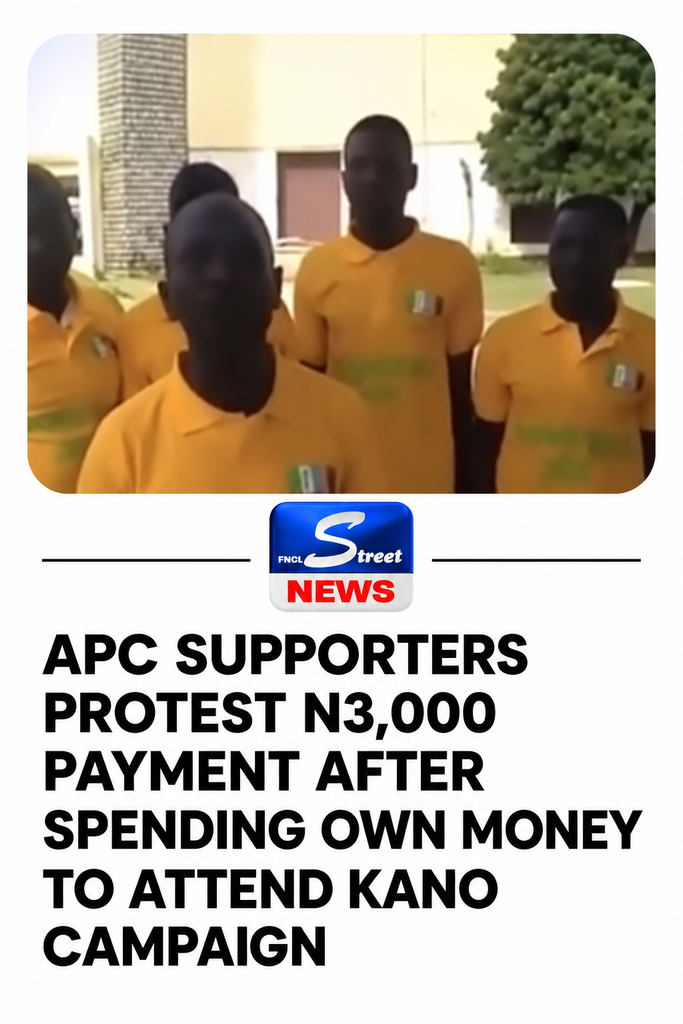
APC SUPPORTERS PROTEST ₦3,000 PAYMENT AFTER SPENDING OWN MONEY TO ATTEND KANO CAMPAIGN
Members and supporters of the All Progressives Congress (APC) who were mobilised from their communities to attend a party campaign event in Kano State have protested over the ₦3,000 reportedly given to them after they spent their own money travelling to the venue.
The supporters expressed anger over what they described as poor treatment during the mobilisation exercise, saying some of them had to spend between ₦1,000 and ₦1,500 from their own pockets to travel to the campaign venue.
The protesters also complained that they were kept waiting for several hours before receiving the ₦3,000 payment, with some saying the amount did not adequately compensate them for the expenses they had already incurred in getting to the event.
One of the representatives of the supporters, identified as Salisu Shaibu, spoke on behalf of the group in a video obtained by Street News Reporters. He expressed strong dissatisfaction with the manner in which the supporters were treated and warned that they would no longer participate in similar mobilisation exercises if the situation continued.
Shaibu, who spoke in Hausa, said the supporters had responded to the party’s mobilisation call and travelled to Kano in good faith, but were disappointed by the treatment they received upon arrival.
He said some of the supporters had been waiting since 7:00 a.m., describing the prolonged waiting period as unacceptable.
According to him, the supporters should not be treated as though their participation and personal sacrifices did not matter simply because they were attending a political campaign.
Shaibu said some members of the group had spent ₦1,000 to reach the venue, while others reportedly spent as much as ₦1,500. He argued that after spending their own money on transportation and other expenses, receiving ₦3,000 after several hours of waiting left many of them dissatisfied.
He further claimed that the financial burden of the trip had extended to the families of the supporters, with some households allegedly having to incur debts or provide money to enable their relatives to travel to the campaign.
The APC supporter said the group had already demonstrated its commitment to the party by attending the event and participating in the mobilisation exercise.
However, he made it clear that their support should not be interpreted as acceptance of what he described as unfair treatment.
Shaibu reportedly warned that the supporters would not agree to participate in similar trips in the future if they were going to be treated in the same manner.
He also said the supporters had given the party their “100 per cent support” and had fulfilled their responsibility by turning out for the campaign.
The protest highlights some of the challenges associated with grassroots political mobilisation in Nigeria, where political parties frequently rely on supporters from different communities to attend rallies, campaign events and other political gatherings.
Such supporters are often transported from their communities to campaign venues, with organisers sometimes providing transportation, feeding allowances or other forms of financial assistance.
However, disagreements can arise when the amount provided does not meet the expectations of those mobilised, particularly when supporters have already spent their personal funds to attend political events.
The Kano incident also underscores the increasing importance of grassroots supporters in the build-up to Nigeria’s 2027 general elections.
Political parties are expected to intensify their mobilisation activities as preparations for the elections gather momentum, with large rallies and campaign events likely to attract supporters from different parts of the country.
For the APC supporters involved in the Kano mobilisation, however, the immediate concern was the amount they received and what they considered inadequate consideration for the expenses and time they had committed.
Shaibu’s comments suggest that the dissatisfaction was not necessarily about supporting the party itself, but about how the supporters believed they were treated during the mobilisation exercise.
He maintained that the group had shown its loyalty by turning up and participating, but argued that political support should not be taken for granted.
The protest also raises broader questions about the relationship between political parties and grassroots supporters, particularly regarding the financial expectations associated with attending campaign events.
While political parties often describe their rallies as voluntary expressions of support, grassroots participants may incur transportation, feeding and other costs when travelling long distances to attend such events.
The Kano protesters’ complaints therefore reflect a recurring issue in Nigerian political mobilisation, where disagreements over transportation allowances and other payments can sometimes overshadow the political message of a campaign.
Street News Reporters understands that the supporters have threatened not to participate in similar mobilisation trips in the future unless their concerns are properly addressed.
The protesters have also maintained that their decision to speak out should not be interpreted as a rejection of the APC, but as an expression of dissatisfaction with the treatment they received during the particular mobilisation exercise.
As political activities continue ahead of the 2027 elections, incidents such as this could place additional pressure on political parties to improve their engagement with grassroots supporters and ensure that mobilisation arrangements are clearly communicated before participants travel.
The APC has not, in the report reviewed, issued a detailed public response to the supporters’ complaints or explained the circumstances surrounding the ₦3,000 payment.
Street News Reporters will continue to monitor the development and any response from the APC or organisers of the Kano campaign.
