



Tinubu Skips UN General Assembly Again As Sonala Olumhense Questions President’s Absence

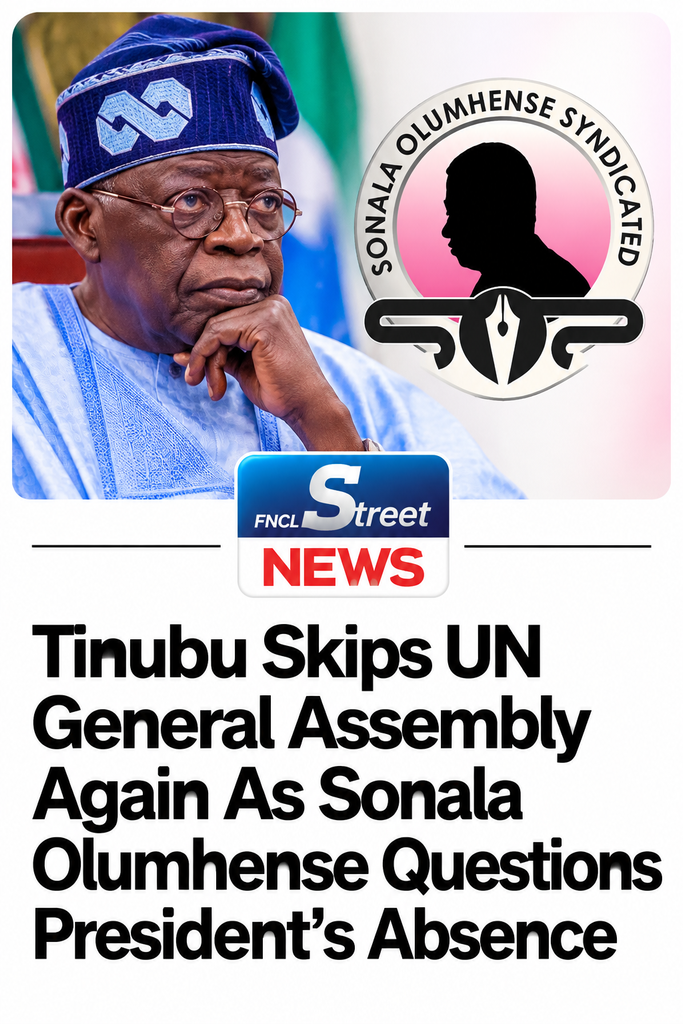
Tinubu Skips UN General Assembly Again As Sonala Olumhense Questions President’s Absence
President Bola Ahmed Tinubu’s decision to stay away from the 81st United Nations General Assembly in New York has come under criticism from columnist Sonala Olumhense, who questioned the President’s repeated absence from the annual global gathering.
In an opinion article published on Sunday, Olumhense recalled his experience working around the United Nations General Assembly and contrasted the prominent role Nigeria once played in international diplomacy with what he described as the country’s reduced visibility under the current administration.
According to Olumhense, Tinubu has attended the United Nations General Assembly only once since becoming President in 2023. He noted that the Nigerian government had earlier announced that Tinubu would attend this year’s gathering before the President extended his stay abroad.
Vice-President Kashim Shettima eventually represented Nigeria at the General Assembly in New York. Shettima delivered Nigeria’s national statement and presented the country’s position on several international issues.
Tinubu’s absence has attracted attention because the President was reportedly in France during the period of the General Assembly. French President Emmanuel Macron, who had hosted Tinubu during his stay in France, also travelled to New York and participated in high-level meetings at the UN.
Olumhense questioned the explanation from the Nigerian government that Tinubu’s absence was linked to “domestic priorities,” arguing that the President was not physically in Nigeria at the time.
The columnist also criticised what he described as Tinubu’s repeated absence from the UN gathering and connected it to broader questions about Nigeria’s international engagement and accountability.
The article further raised concerns about the simultaneous absence of Tinubu and Shettima from Nigeria. At the time, Tinubu was abroad while Shettima was in New York representing the country at the UN General Assembly.
Olumhense argued that the situation raised questions about the constitutional arrangements governing presidential absence from the country. He specifically referred to the constitutional requirement concerning the transmission of power when a President is unable to discharge his functions.
The columnist also used the occasion to discuss Nigeria’s political and governance challenges ahead of the 2027 elections. He referred to the Independent National Electoral Commission’s recently released list of candidates and raised concerns about unresolved corruption and misconduct allegations involving some politicians.
Olumhense cited several reports and civil society assessments concerning corruption cases, public spending and the implementation of Nigeria’s federal budget. He argued that these issues showed what he described as a gap between political accountability and the pace at which elections are conducted.
The article also referenced a U.S. State Department fiscal transparency assessment which criticised aspects of Nigeria’s budget documentation and fiscal reporting. It further cited claims concerning constituency projects and alleged irregularities in public spending.
However, the claims and assessments cited in the opinion piece represent matters of ongoing public debate and, in several cases, allegations or findings attributed to specific organisations and reports rather than court-established wrongdoing.
Olumhense acknowledged some of Tinubu’s economic reforms, particularly the removal of the fuel subsidy and changes to the naira exchange-rate regime. He nevertheless argued that these measures did not resolve what he described as broader concerns about governance and accountability.
The columnist ultimately called on Tinubu to engage more directly with Nigerians, particularly as the country moves toward the 2027 elections.
He suggested that Tinubu’s upcoming National Day address could provide an opportunity for the President to speak directly to Nigerians about his administration’s record, challenges and plans.
The debate over Tinubu’s absence from the UN General Assembly comes as Nigeria continues to participate in the gathering through its delegation led by Vice-President Shettima.
Shettima has used the 81st General Assembly to present Nigeria’s positions on issues including reform of the UN Security Council, African representation in global institutions, peace and security, and international development.
Tinubu’s absence from this year’s General Assembly and the reasons surrounding his decision remain subjects of political and public discussion.
