



Education Minister Expresses Disappointment As Only 18 Of 78 Federal University VCs Attend Advancement Forum

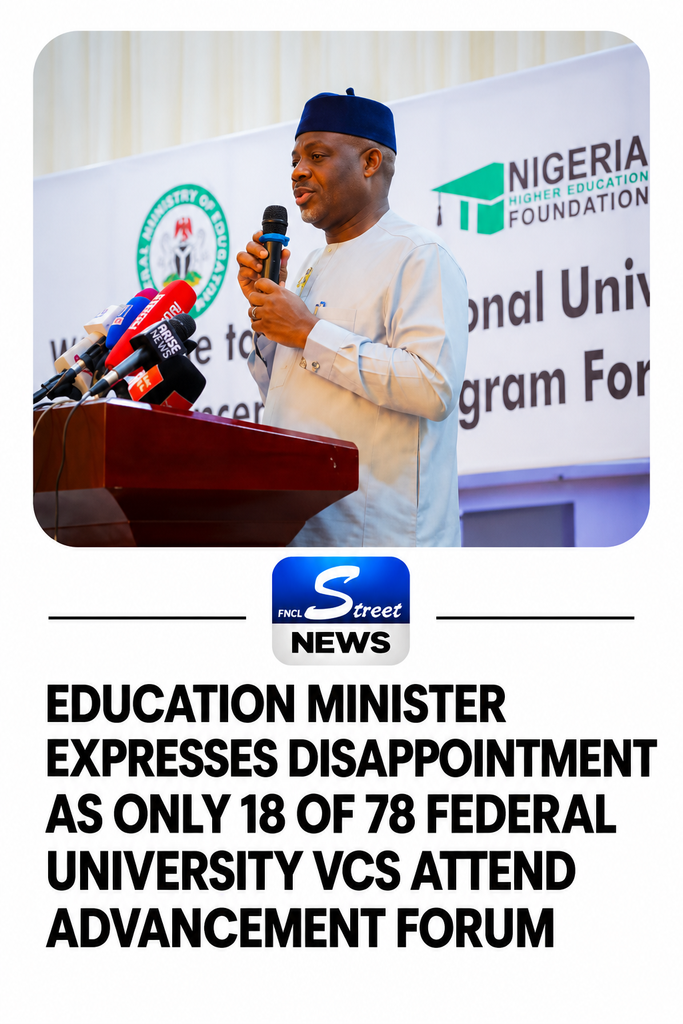
Education Minister Disappointed As Only 18 Of 78 Federal University VCs Attend Advancement Forum
Nigeria’s Minister of Education, Dr Tunji Alausa, has expressed disappointment over the poor attendance of Vice Chancellors at the Nigeria Higher Education Foundation (NHEF) National University Advancement Programme Forum.
Alausa disclosed that only 18 Vice Chancellors attended the forum, despite describing the programme as critical to improving the financial sustainability of Nigerian universities.
The minister made the disclosure in a post on X on Wednesday, where he criticised the low level of participation by heads of the nation’s federal universities.
“I was disappointed yesterday,” Alausa said, referring to the attendance at the NHEF National University Advancement Programme Forum.
He revealed that only 30 of Nigeria’s 78 federal universities had participated in the Federal Ministry of Education-NHEF Advancement Programme in the first place.
“For something this important to the future and financial sustainability of our universities, we must do better,” the minister said.
Alausa said he had, since assuming office, encouraged universities to strengthen their Advancement Offices and develop alternative sources of funding instead of relying almost entirely on government allocations.
According to the minister, universities have significant opportunities to generate funds through alumni networks, research grants, philanthropy, endowments and partnerships with the private sector.
“Our universities are sitting on enormous opportunities through their alumni, research grants, philanthropy, endowments and private-sector partnerships. Yet too many have deprioritised the very structures needed to unlock them,” he said.
The minister said he had consequently directed Vice Chancellors to rebuild and adequately staff their Advancement Offices and place the offices directly under the authority of the Vice Chancellor.
“So today, I gave our Vice Chancellors a clear directive: rebuild and properly staff your Advancement Offices. Place them directly under the Office of the Vice Chancellor,” Alausa said.
He further instructed university managements to provide advancement professionals with the stability, access and institutional support required to attract funding and fully utilise training and platforms provided by NHEF.
“This is no longer a suggestion. It is a mandate,” the minister declared.
Alausa stressed that the Federal Government remained committed to funding education under President Bola Tinubu but argued that university authorities also had a responsibility to develop additional sources of revenue.
“President Bola Tinubu has made it clear that this administration will not renege on its commitment to education. However, finding new sources of funding is also part of the responsibility of every Vice Chancellor,” he said.
The minister advocated blended financing as a means of strengthening university autonomy, identifying research grants, alumni contributions, philanthropy, private-sector investment and endowment funds as potential sources of additional revenue.
He said Nigeria could adapt successful university funding models from other countries to strengthen its higher education institutions.
“We are not reinventing the wheel. We will take what works globally, adapt it to Nigeria and build institutions that can thrive for generations,” Alausa said.
The minister also acknowledged the contribution of Wale Adeosun, Founder and CEO of Kuramo Capital Management, alongside the NHEF team, for their partnership with the Federal Ministry of Education and efforts to strengthen Advancement Offices across federal universities.
Alausa told Vice Chancellors that universities could no longer depend entirely on government funding and urged them to take greater responsibility for building financially sustainable institutions.
“To our Vice Chancellors: the era of waiting for government to fund everything must end,” he said.
“Build the structures. Mobilise the resources. Strengthen your institutions. That is your responsibility, and it must become part of your legacy.”
