



TINUBU SAYS NIGERIANS CAN INSULT, ATTACK HIM ‘WITHOUT MIDNIGHT TROUBLES’ AMID SOWORE’S DSS PROSECUTION

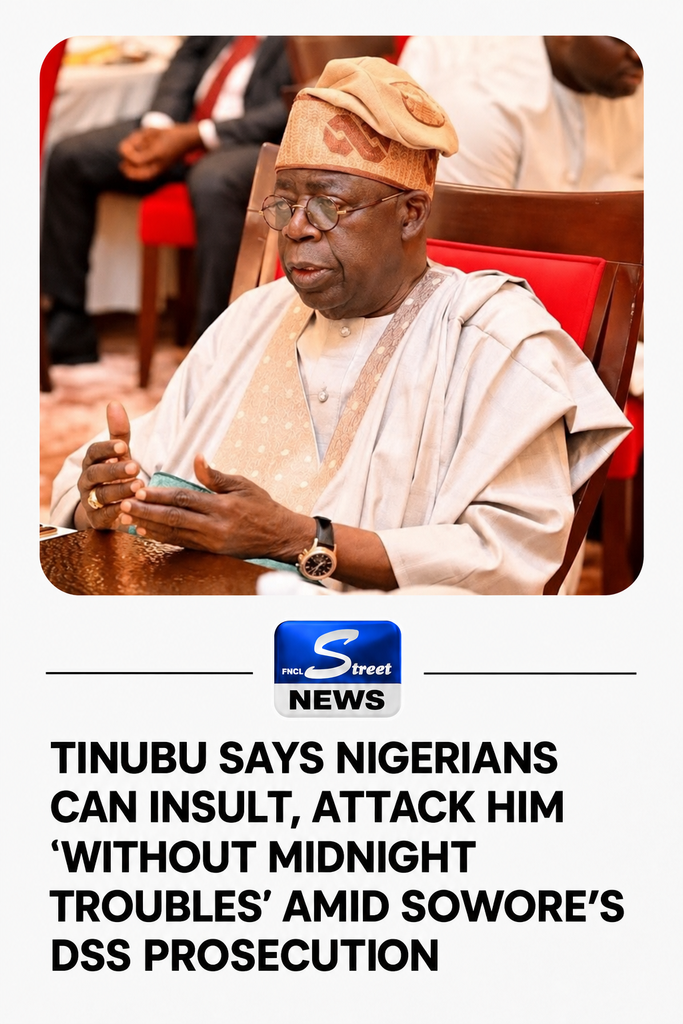
Tinubu Says Nigerians Can Insult, Attack Him Without ‘Midnight Troubles’ Amid Sowore’s DSS Case
President Bola Tinubu has said Nigerians are free to criticise or publicly attack him without fear of government reprisals, describing tolerance for dissent as part of his administration’s commitment to democratic values and press freedom.
Tinubu spoke on Thursday in Abuja at the centenary celebration of Daily Times of Nigeria Limited, where the Nigerian Grand Book was unveiled and the Times Heroes Awards were presented.
The President was represented at the event by the Secretary to the Government of the Federation, George Akume.
According to Tinubu, the freedom of citizens to openly criticise those in power without facing retaliation reflects his administration’s commitment to press freedom and democratic principles.
“The President recognises the role of the media in shaping the destiny of the nation, and hence his commitment, in line with the Constitution of our country, to the freedom of the press,” Akume said while representing Tinubu.
“Let us admit openly that under this government, you can insult and attack the President and still go to bed without midnight troubles,” he added.
Tinubu also highlighted the role of the media in Nigeria’s democratic development, saying the country’s current challenges were the result of structural problems that had accumulated over several decades.
He said his administration’s reform programme was designed to address deeper economic and institutional challenges rather than provide temporary solutions.
According to the President, the reforms are aimed at strengthening Nigeria’s fiscal position, improving productivity, attracting investment, developing infrastructure, strengthening institutions and creating greater opportunities for young Nigerians.
He said the ultimate goal was to put Nigeria on a stronger footing to compete effectively in the global economy.
Speaking on the significance of Daily Times’ 100th anniversary, Tinubu described the milestone as a testament to the newspaper’s endurance and continued relevance to Nigeria’s development.
He said the newspaper had played more than a reporting role, describing it as an important participant in documenting and shaping the country’s history.
Tinubu also unveiled the Nigerian Grand Book, a publication designed to preserve Nigeria’s institutional memory and document the contributions of citizens who have played significant roles in national development.
He said the initiative would enable Nigerians to tell their own story, draw lessons from the past and prepare for the future.
The President further raised concerns about Nigeria’s projected population growth, noting that the country could have about 450 million people by 2050.
He said the projected increase would have significant implications for food security, water resources and other areas of national planning.
Tinubu commended the management of Daily Times and the Chairman of Folio Media Group, Fidelis Anosike, for their efforts to preserve the newspaper’s legacy and urged the publication to remain relevant for another century.
Anosike said Daily Times officially marked its centenary on June 26, 2026, describing the Nigerian Grand Book as part of efforts to revive the newspaper and reposition it for the future.
The event attracted prominent political, business and media figures, including Deputy Speaker of the House of Representatives Benjamin Kalu, governors and their representatives, ministers, presidential candidate Peter Obi, Vanguard Publisher Sam Amuka, ThisDay Publisher Nduka Obaigbena and former African Development Bank President Akinwumi Adesina.
Adesina, who delivered the keynote address, commended Daily Times for its longstanding contribution to the development of journalism in Nigeria.
Sowore’s DSS Case
Tinubu’s comments come amid the controversy surrounding the Department of State Services (DSS) case against human rights activist and African Action Congress presidential candidate for the 2027 election, Omoyele Sowore.
The DSS initiated a cybercrime case against Sowore in 2025 after he referred to Tinubu as a “criminal” in a social media post.
Meta and X were initially joined as defendants in the case, but the court later struck them out, leaving Sowore as the sole defendant. He pleaded not guilty and described the charges as politically motivated.
Sowore was granted bail under strict conditions, including a ₦200 million bond and the surrender of his passport.
The DSS had justified its actions by arguing that its mandate extended beyond the physical protection of the President to shielding him from what it described as “psychological attacks.”
In correspondence with Meta, the agency also argued that Sowore’s remarks could destabilise public order and undermine the presidency.
However, with the 2027 presidential election approaching, the DSS has moved to suspend the case, citing concerns that continuing the trial could infringe on Sowore’s constitutional right to contest the election.
The development has renewed debate over the balance between freedom of expression, political dissent and the powers of security agencies in Nigeria.
While Tinubu’s latest remarks seek to project his administration as tolerant of criticism and committed to press freedom, the Sowore case has continued to draw scrutiny over the treatment of outspoken government critics.
