



NIGERIA’S DEADLIEST QUARTER SINCE 1997 PUTS TINUBU’S 2027 RE-ELECTION BID UNDER PRESSURE – REPORT

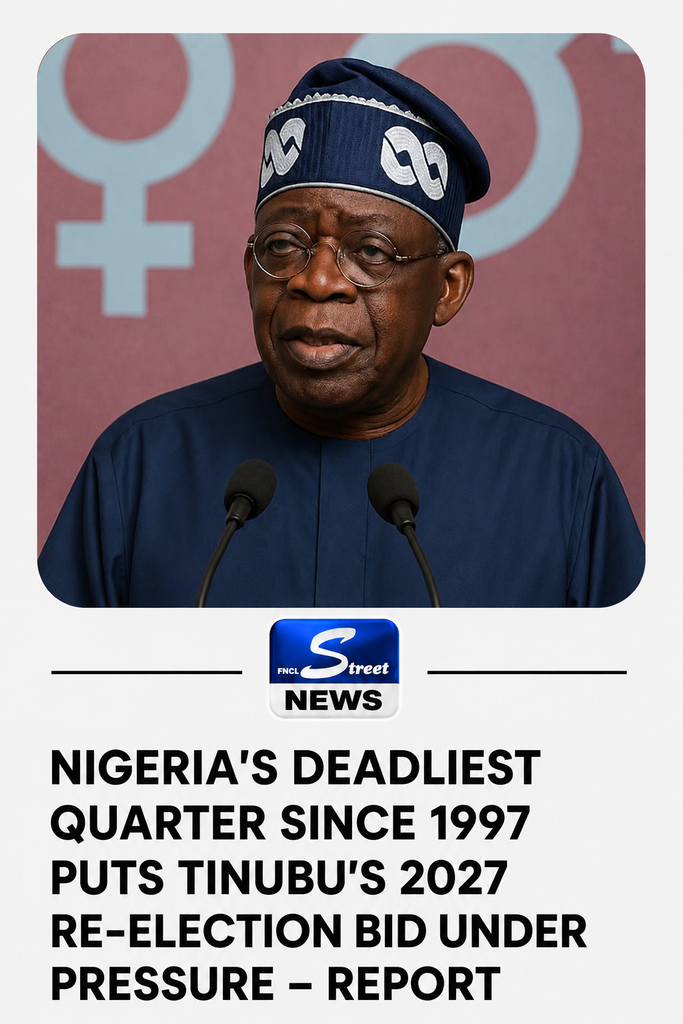
Nigeria’s Most Violent Quarter Since 1997 Tests Tinubu’s 2027 Re-Election Bid – Report
Nigeria’s worsening security crisis could pose a major challenge to President Bola Tinubu’s bid for a second term, as new data shows a sharp increase in attacks targeting civilians and identifies the second quarter of 2026 as the country’s most violent quarter in decades.
Table Of Content
Ladd Serwat, a senior Africa analyst at the Armed Conflict Location & Event Data Project (ACLED), told Semafor Africa that the second quarter of 2026 was the most violent period recorded in Nigeria since the organisation began collecting data in 1997.
According to Serwat, ACLED data also shows a 30 per cent increase in attacks targeting civilians by insurgents and bandit groups in Nigeria this year.
“The spread and intensification of armed banditry across northern and central Nigeria” was a major driver of the escalation, Serwat said.
The assessment comes amid a renewed wave of kidnappings and attacks across the country, including the mass abduction of hundreds of people from mosques in northern Nigeria.
The latest incidents followed the death in captivity of a retired army general who was kidnapped while travelling to a wedding, as well as the abduction of more than 100 travellers in two separate incidents in the North-West.
President Tinubu, who began a three-week vacation in Europe on Sunday, ordered the military and police to launch a rescue operation for about 600 people reportedly kidnapped in Niger State.
Security Crisis Creates Political Challenge
The worsening security situation comes at a politically sensitive period for Tinubu, who is seeking re-election in 2027.
Although the administration has repeatedly highlighted its economic reforms and achievements, critics and security analysts say it has been less vocal about its record in tackling insecurity.
Tinubu’s 2023 presidential manifesto promised a “proactive and intelligence driven security approach,” but his administration has largely focused its first three years on addressing the country’s economic difficulties.
A recently released scorecard of the President’s three-year performance also placed significant emphasis on economic reforms and achievements.
“Certainly in the first couple of years of this administration, insecurity did not seem to be the priority,” said James Barnett, a non-resident fellow at the Hudson Institute who has lived and researched conflict in Nigeria.
“That doesn’t mean there weren’t security policies being implemented, but it was not really getting the top level engagement,” he added.
The security crisis has increasingly become a political issue, with opposition figures Atiku Abubakar and Peter Obi, who were among Tinubu’s major challengers in the 2023 presidential election, pledging to recruit more security personnel and decentralise security management if elected.
Tinubu, meanwhile, has backed legislation that would allow Nigerian states to establish their own police forces and has tasked a security committee with developing a five-year strategic defence operations plan.
Kidnappings, Banditry Deepen Public Anxiety
The frequency of kidnappings and attacks has nevertheless heightened public anxiety, with Nigerians increasingly facing the threat of abduction in places ranging from churches and mosques to schools, highways and residential areas.
Since taking office, Tinubu has introduced sweeping economic reforms, including the removal of the petrol subsidy, naira devaluations, changes to tax laws and measures aimed at attracting investment into the oil and gas sector.
However, critics and security analysts argue that the government has not demonstrated a comparable level of urgency in confronting the country’s security crisis.
“Despite sustained military pressure, there’s no evidence that Nigeria’s insecurity is abating in substantial terms,” Taiwo Hassan Adebayo, a researcher at the Institute for Security Studies in South Africa, told Semafor.
Adebayo said security planners needed to examine how armed groups obtain weapons, fuel their motorcycles and maintain internet connectivity in remote areas.
Ransom Payments Surge
The insecurity has also become increasingly lucrative for criminal groups.
Between July 2025 and July 2026, ransom payments linked to abductions in Nigeria tripled to $5.8 million, according to Nigeria-based research organisation SBM Intelligence.
The organisation also reported a 66 per cent year-on-year increase in the number of kidnapping victims.
Analysts say Nigeria’s security landscape has become increasingly complicated by the expansion of rival Boko Haram factions and al-Qaeda affiliates such as JNIM, which are reportedly competing for influence and territory.
The proliferation of armed groups has also made it increasingly difficult to distinguish between them and accurately determine responsibility for particular attacks.
Dengiyefa Angalapu, an analyst at the Centre for Democracy and Development in Abuja, said some groups initially invited to help communities defend themselves against insurgents had subsequently evolved into terrorist organisations.
One example is Lakurawa, which entered Nigeria from the Sahel after some communities in the North-West resorted to self-defence measures against insurgents.
Nigeria subsequently declared the group a terrorist organisation over its alleged links to al-Qaeda.
Angalapu said the changing identities and alliances of armed groups had further complicated the country’s fight against insurgency and guerrilla warfare.
“They sometimes mix very well with their communities. Sometimes they are bandits by night, and community members by day,” he said.
Nigeria Faces Multiple Security Threats
Nigeria’s security challenges extend beyond terrorism and banditry.
Farmer-herder conflicts, separatist activities in the South-East and oil theft in the Niger Delta have also contributed to what Jervin Naidoo, a political analyst at Oxford Economics Africa, described as an “increasingly layered and geographically dispersed” security crisis.
The situation has raised concerns about the impact of insecurity on businesses, investment and the wider economy.
Following a reported coup threat late last year, Tinubu reshuffled the military’s top leadership. The new military leadership subsequently participated in a joint operation with the United States in December targeting terrorist enclaves.
This year, the President approved salary increases for military personnel and created additional army units, while National Security Adviser Nuhu Ribadu has met with US officials several times since November to brief Washington on Nigeria’s efforts to prosecute terrorists and combat terrorist financing.
Barnett, however, said much of the government’s response had focused on managing its international relationships.
“A lot of the Nigerian government’s reaction has had to do with managing diplomatic relations,” he said.
While acknowledging that improved military pay and increased firepower were positive measures, Barnett said it remained uncertain whether the administration would sustain the political momentum required to implement deeper structural reforms beyond the 2027 election.
Some Analysts Defend Tinubu’s Security Record
Not all assessments of Tinubu’s security record have been negative.
Ebenezer Obadare, a Council on Foreign Relations Senior Fellow for African Studies, identified several military operations under the Tinubu administration that resulted in the rescue of hostages.
He argued that the President had made significant progress in some areas of the security fight, pointing to the killing of several high-profile terror group leaders and more than 1,000 terrorists with US assistance.
According to Obadare, these developments suggest that the tide in Nigeria’s prolonged battle against jihadist insurgency may have shifted in favour of government forces.
However, he acknowledged that Nigeria’s security situation “remains critical” and said continued cooperation with the United States would be necessary for the foreseeable future.
US Raises Pressure On Nigeria
Nigeria’s security situation has also attracted increasing attention in Washington.
The US Department of Defense plans to withdraw about 200 troops deployed to Nigeria in February as part of the Trump administration’s counter-terrorism assistance programme. The Pentagon said the mission had generated “significant security returns.”
President Donald Trump’s aides and Republican political allies have increasingly framed US security engagement with Nigeria around the protection of Christians, whom they accuse jihadist groups of particularly targeting.
The issue remains a major focus of a joint working group that said Abuja had taken steps to prosecute hundreds of terror suspects and strengthen its law enforcement capacity.
Nigeria has reportedly spent at least $9 million on lobbying in the United States to counter concerns about the Tinubu administration’s commitment to tackling insecurity.
However, the spending has not stopped Trump allies, including US Senator Ted Cruz, chairman of the Senate’s Africa subcommittee, from threatening sanctions and an aid freeze over what they describe as “mass violence against Christians and religious minorities.”
As the 2027 elections approach, the scale and persistence of Nigeria’s security crisis could therefore become a major test for Tinubu’s administration, particularly as voters assess whether the government’s security measures have translated into safer communities across the country.
Street News Reporters will continue to monitor developments surrounding Nigeria’s security situation and its potential impact on the 2027 elections.
