



ABUJA-KADUNA HIGHWAY GRIDLOCK LEAVES TRAVELLERS STRANDED FOR DAYS AS ARMED YOUTHS DEMAND ‘CLEARANCE FEES’

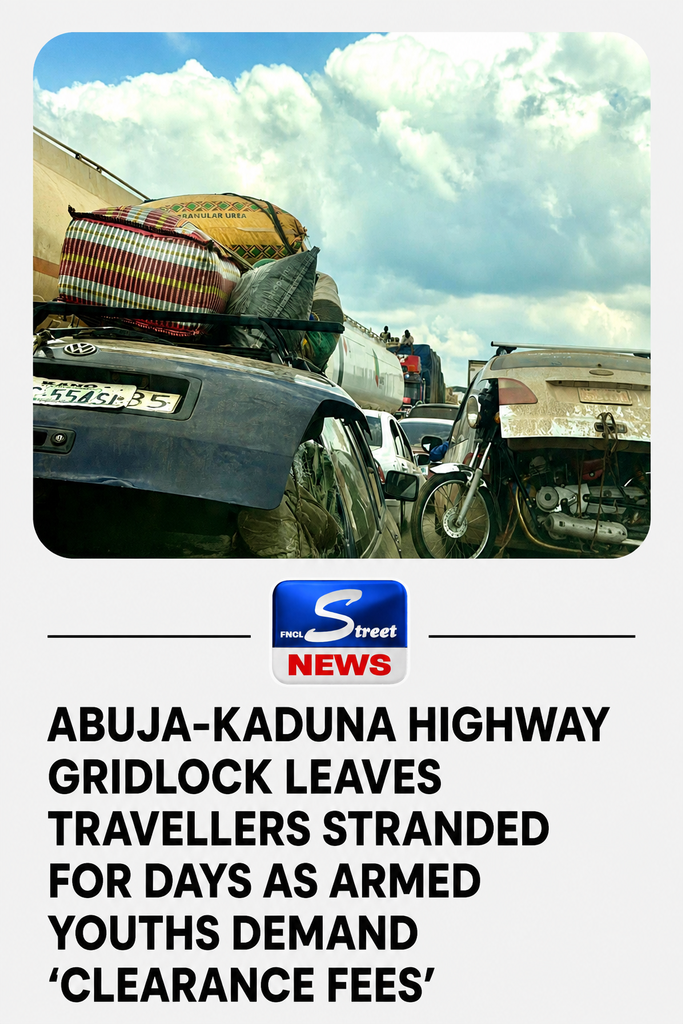
Abuja-Kaduna Highway Gridlock Leaves Travellers Stranded For Days As Alternative Routes Turn Risky
The Abuja-Kaduna Expressway has been hit by severe traffic gridlock, leaving hundreds of travellers, motorists and truck drivers stranded for days despite billions of naira reportedly committed by the Federal Government to the construction and rehabilitation of the strategic highway.
The worsening congestion, which began on Saturday, August 22, 2026, has reportedly forced some travellers and drivers to spend up to three days on the road, with long queues of vehicles, particularly articulated trucks, stretching across affected sections of the highway.
Motorists have faced significant delays as they struggle to navigate the congested and difficult sections of the road linking the Federal Capital Territory with Kaduna and other parts of northern Nigeria.
The latest gridlock has raised fresh concerns over the effectiveness of government spending and ongoing construction on the Abuja-Kaduna-Kano corridor, especially as road users continue to endure severe hardship on one of the country’s most important transport routes.
In August 2026, the Federal Government reportedly said 80 per cent of the construction cost of the Abuja-Kaduna-Kano highway had been paid, with completion targeted for November. The payments were reportedly worth more than N600 billion, against an estimated total construction cost of N752 billion.
Despite the huge financial commitment, motorists continue to experience prolonged congestion, prompting questions over whether the expenditure is translating into improved road access, safety and smoother movement.
Records reviewed by STREET NEWS REPORTERS also show that the Federal Ministry of Works spent N313.2 million on separate interventions and engineering work on the Abuja-Kaduna Road between September 2024 and February 2025.
On September 11, 2024, N180.7 million was reportedly paid to Dankudan International Limited for repairs to a bridge at kilometre 68+850 along the Abuja-Kaduna Road in Kaduna State.
On February 25, 2025, another N132.46 million was paid to Yolas Consultants Ltd for the production of an engineering design for the review of the Abuja-Kaduna Road across the FCT, Kaduna and Kano states.
The two payments amounted to approximately N313.2 million and were intended to address specific infrastructure and engineering needs along the highway.
Alternative Routes Create Fresh Security Concerns
With the main highway severely congested, some motorists have reportedly resorted to alternative routes through surrounding villages in an attempt to escape the gridlock.
However, the diversions have allegedly created another problem. Armed youths in some communities reportedly mounted roadblocks and demanded payments from travellers before allowing them to pass.
Some of the youths allegedly described the payments as “clearance fees” for passage through their communities, adding another layer of difficulty and security concerns for already stranded motorists.
The Kateri-Jere-Zuba stretch is particularly significant as it forms part of the first section of the ongoing Abuja-Kaduna-Kano Super Highway project. Although reports earlier indicated that substantial concrete pavement work had been completed on the Zuba-Jere section, construction and traffic management activities remain ongoing across parts of the wider corridor.
The continued congestion has therefore intensified questions about how construction activities are being managed and why motorists are still experiencing severe disruptions despite substantial government expenditure.
Highway Congestion Raises Wider Concerns
The Abuja-Kaduna Expressway has a long history of traffic congestion, particularly involving articulated trucks. Previous incidents have seen thousands of motorists trapped for hours after trailers blocked sections of the highway.
Former Kaduna Central Senator Shehu Sani also reacted to the latest situation, expressing concern over the reported blockage of the highway by trailer drivers and the risks posed by large numbers of stranded motorists.
The prolonged gridlock has also heightened security concerns, as travellers are being forced to remain on the highway for extended periods, while those seeking alternative routes may face additional risks in unfamiliar communities.
The Abuja-Kaduna corridor is a major transportation link between the Federal Capital Territory, Kaduna and other northern states, carrying passenger vehicles, commercial trucks and goods on a daily basis.
A prolonged disruption could therefore have wider economic consequences, particularly for the movement of agricultural produce, commercial goods and essential services between Abuja and northern Nigeria.
For many travellers, what should ordinarily be a relatively direct journey between Abuja and Kaduna has reportedly become a multi-day ordeal.
The latest crisis has renewed calls for urgent intervention to ease the congestion, improve traffic management, address security concerns on alternative routes and ensure that ongoing construction works do not unnecessarily restrict movement.
With more than N600 billion reportedly already paid towards the Abuja-Kaduna-Kano highway project, in addition to the N313.2 million spent on specific Abuja-Kaduna Road interventions, expectations remain high that motorists should begin to see tangible improvements in road conditions, safety and travel time.
